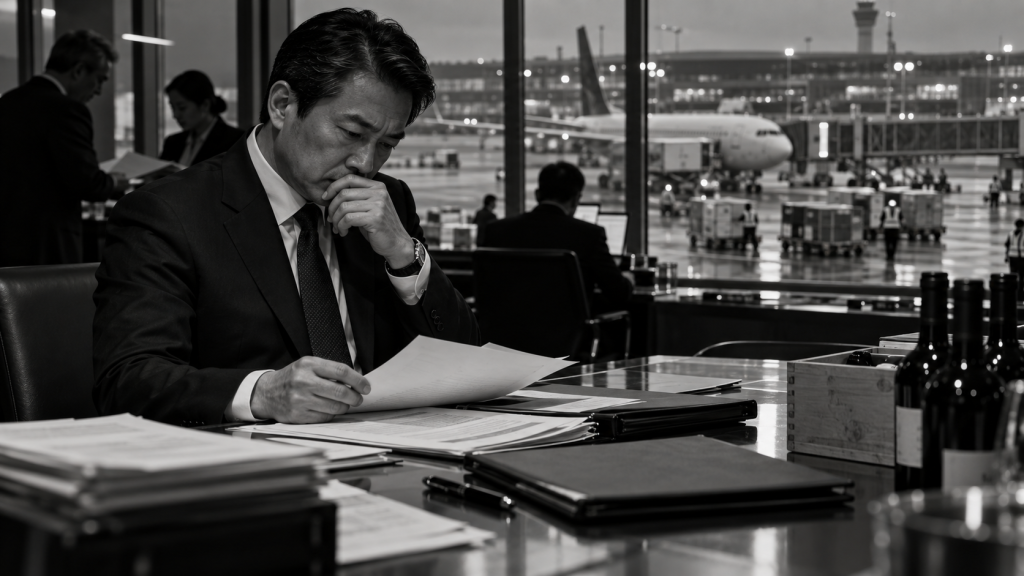
Workplace Investigation Thailand: Performance Failure or Misconduct Allegation?
Workplace investigation Thailand cases become particularly difficult when performance concerns and allegations of misconduct emerge at the same time.
The suspension of Thai Airways chief executive Chai Eamsiri from CEO duties on 2 October 2026 provides a useful example.
Thai Airways’ official disclosure to the Stock Exchange of Thailand said the board was responding to operational disruption following flooding in late September that affected the airline’s business and reputation. The board ordered a fact-finding investigation and review of the company’s crisis-management processes, asked Chai to stop performing CEO duties during that review, and appointed an acting CEO. Weblink
Thai Airways’ official 2 October disclosure to the SET
Separate media reports later discussed allegations concerning the procurement of wine for onboard service. Chai publicly denied corruption or improper interference and said the procurement followed established procedures that could be independently reviewed. Khaosod English
These are important distinctions.
An operational performance investigation and a procurement misconduct allegation may involve the same executive while still being completely different investigative questions.
And neither should be treated as proven merely because an employee has been suspended.
For companies, boards and legal teams, the real question is therefore:
How can an independent investigation establish whether disciplinary action is genuinely based on performance or misconduct — or whether an allegation is unsupported, exaggerated or potentially being used to justify a decision already made?
That is where a properly structured workplace investigation becomes valuable.
Compliancia workplace investigation services in Thailand
Suspension Is Not the Same as Dismissal
The terminology matters.
Based on Thai Airways’ official disclosure, Chai was instructed to stop performing CEO duties while the fact-finding process took place.
That is not the same thing as a finding of misconduct.
It is also more precise than describing the development simply as a “layoff”.
A suspension or temporary removal from duties can be an interim governance measure designed to:
- Protect an investigation
- Stabilise operations
- Prevent interference with evidence
- Allow independent interviews
- Reassign decision-making authority
- Protect employees or stakeholders
Whether that suspension is ultimately justified depends on what the investigation establishes.
For investigators, the starting assumption should therefore be neutral:
The suspension creates a question to investigate. It does not answer that question.
Two Different Issues Need Two Different Investigations
The Thai Airways case demonstrates why investigators should define allegations carefully.
Issue 1: Operational performance
Thai Airways said its board was responding to disruptions following flooding, including effects on the airline’s operations and corporate reputation. The company ordered a review of how the crisis had been managed. Weblink
That investigation might examine:
- What happened operationally?
- When did management become aware of the problem?
- Were contingency plans activated?
- Was staffing adequate?
- Were third-party suppliers properly managed?
- Were executives given accurate information?
- Were escalation procedures followed?
- Could the disruption reasonably have been prevented?
Those are primarily management and performance questions.
Issue 2: Procurement allegations
Separately, media reports said questions had been raised concerning a large procurement of wine for onboard service.
Thai Airways’ own procurement website confirms that the airline issued a request for proposals in October 2025 covering red wine, white wine and other wine products for 2026. That procurement notice establishes the existence of a wine tender, but it does not prove any allegation concerning interference or corruption. Thai Airways
Thai Airways’ published 2026 wine procurement notice
Media reports referred to approximately 860,000 bottles and a transaction value reported at more than ฿800 million or close to ฿1 billion. Chai denied wrongdoing and said the process complied with procurement rules and was open to examination. Khaosod English
Chai Eamsiri’s reported response to the procurement allegations
The investigation therefore should not begin with:
“How do we prove corruption?”
It should begin with:
“What actually happened during the procurement?”
What a Workplace Investigation in Thailand Should Test
A credible internal investigation should test both incriminating and exculpatory evidence.
It should be capable of producing the same conclusion regardless of who commissioned it.
That normally requires several investigative steps.
1. Build the Timeline Before Drawing Conclusions
Chronology is often the quickest way to distinguish a real concern from a narrative created afterwards.
Investigators should establish:
When did the performance issue occur?
When was management first concerned?
When was an investigation discussed?
When did the procurement allegation emerge?
When was suspension considered?
When was the final decision taken?
Timing can reveal whether the issues genuinely developed together or were combined only later.
For example, if documented performance concerns existed months before a procurement allegation, that supports one interpretation.
If misconduct allegations appeared only after a decision had already been made to remove an executive, that may require a different explanation.
Neither scenario proves wrongdoing.
But chronology identifies the questions that need answering.
2. Test Performance Against Objective Evidence
A performance-based decision should normally be supported by measurable evidence.
Investigators may examine:
- KPIs
- Service-level agreements
- Operational reports
- Internal warnings
- Incident reports
- Emails
- Board minutes
- Customer complaints
- Supplier performance
- Previous reviews
- Crisis procedures
The key question is:
Was this executive actually responsible for the failure being attributed to them?
Large organisations have complicated reporting structures.
A CEO may ultimately be accountable for corporate performance while specific failures originate deeper within operational teams, contractors or management systems.
Investigative work should distinguish executive accountability from direct operational responsibility.
3. Reconstruct the Procurement Process
Procurement allegations should be examined transaction by transaction.
Investigators may review:
- Tender documents
- Bid specifications
- Vendor submissions
- Evaluation criteria
- Approval records
- Pricing
- Competing quotations
- Committee minutes
- Emails
- Contract amendments
- Purchase orders
- Payments
The objective is to determine whether the documented process matches the process that actually occurred.
Compliancia supports companies and legal teams with corporate and internal investigations involving document review, stakeholder mapping and discreet enquiries.
Compliancia corporate investigation services
4. Identify Who Made the Decision
Senior executives are often blamed for decisions because their names sit at the top of the organisation.
That does not necessarily explain who actually made a procurement decision.
Investigators should determine:
- Who drafted the specification?
- Who selected potential suppliers?
- Who evaluated bids?
- Who negotiated terms?
- Who approved the purchase?
- Who could override the committee?
- Did anyone intervene outside their formal authority?
If an allegation says an executive “interfered”, that word needs to be converted into an investigable proposition.
What exactly did the person do?
Without that specificity, an allegation can be impossible to prove or disprove.
5. Follow Relationships, Not Rumours
Procurement concerns often involve alleged relationships between employees and vendors.
Investigators may therefore examine:
- Company shareholders
- Directors
- Beneficial owners
- Family connections
- Previous employment
- Related companies
- Common addresses
- Financial relationships
- Undisclosed conflicts of interest
A supplier being selected is not evidence of corruption.
But an undisclosed relationship between a decision-maker and a supplier could materially change the risk assessment.
This is where corporate intelligence and beneficial-ownership research can supplement an internal document review.
Compliancia company due diligence services
6. Interview the People Around the Decision
Documents rarely tell the whole story.
An effective workplace investigation may require interviews with:
- Procurement employees
- Finance personnel
- Operational management
- Legal or compliance teams
- Executive assistants
- Committee members
- Vendors
- Relevant witnesses
The purpose is not simply to ask whether someone thinks misconduct occurred.
Good investigators ask factual questions:
What did you see?
What instruction were you given?
Who was present?
Was anything unusual?
What documents exist?
Witness accounts should then be tested against records and other evidence.
7. Test the Allegation Itself
Investigators should investigate the source and quality of the allegation, not merely the accused employee.
Questions can include:
- Who first raised the concern?
- Was it based on firsthand knowledge?
- Was supporting evidence provided?
- Had the allegation changed over time?
- Were important facts omitted?
- Did the source have a dispute with the subject?
- Can independent evidence corroborate the claim?
This does not mean attacking a whistleblower’s credibility.
It means distinguishing between:
information, inference, suspicion and evidence.
An allegation made in good faith may ultimately prove incorrect.
Conversely, an allegation initially supported by little evidence may eventually be corroborated.
The investigator should determine which is which.
When Could an Allegation Be Pretextual?
Companies sometimes ask investigators whether misconduct has been alleged simply to justify a decision already made for commercial, political or interpersonal reasons.
That possibility should be investigated cautiously.
Potential warning signs can include:
- No documented concern before suspension
- Allegations changing after investigation begins
- Policies applied inconsistently
- Similar conduct being tolerated for other executives
- Evidence selected only after the decision
- Witnesses being pressured toward a particular account
- Findings drafted before interviews are complete
- Exculpatory evidence being ignored
None of these automatically proves a manufactured allegation.
But they may justify closer examination of the decision-making process.
A credible investigation must be willing to conclude either:
the allegation is supported, or
the evidence does not support it.
When Does a Performance Issue Become an Internal Investigation?
Not every management failure requires private investigators.
Sometimes poor performance is simply poor performance.
An independent investigation becomes more valuable where there are conflicting accounts, allegations of misconduct, suspected conflicts of interest, disputed procurement decisions, possible information suppression or concern that internal decision-makers are not independent.
Compliancia’s approach to a workplace investigation in Thailand can include:
- Witness interviews
- Document reconstruction
- Corporate intelligence
- Source enquiries
- Background research
- Conflict-of-interest analysis
- Beneficial-ownership research
- Evidence gathering
- Discreet field enquiries
The goal is not to prove management right or the employee wrong.
It is to determine what the available evidence supports.
The Thai Airways Case: What Can We Actually Say?
Based on the public material available as of 6 October 2026, several points can be stated carefully.
Thai Airways officially suspended Chai from performing CEO duties while conducting a fact-finding review arising from operational disruption following late-September flooding. Weblink
Separate media reporting connected scrutiny of wine procurement with the broader controversy, including a reported purchase involving approximately 860,000 bottles. Chai denied corrupt conduct and said procurement followed applicable procedures. Khaosod English
The airline’s procurement portal independently confirms that a wine RFP for 2026 was publicly issued in October 2025. Thai Airways
What the currently reviewed sources do not establish is that Chai committed corruption, that a formal criminal corruption charge has been filed, or that the wine allegation was definitively the reason for his suspension.
It would therefore be premature to describe this publicly as either:
“a justified corruption dismissal”
or
“a fabricated allegation designed to remove the CEO.”
Both conclusions would go beyond the evidence presently available.
Why Independent Workplace Investigations Matter
For boards, legal counsel and companies, this is exactly the type of situation where independent investigation can protect both sides.
If misconduct occurred, a proper investigation helps establish it through evidence.
If allegations are unsupported, the same process can prevent reputational damage and an unfair disciplinary decision.
The investigation should ultimately answer:
What happened?
Who was responsible?
What evidence exists?
Were company procedures followed?
Were allegations independently corroborated?
Did the decision-making process remain fair?
That is the difference between corporate investigation and corporate politics.
Workplace Investigation Services in Thailand
Compliancia provides discreet investigative support for companies, boards, legal teams and counsel handling sensitive internal matters in Thailand and across Southeast Asia.
Relevant matters can include:
- Employee misconduct
- Procurement concerns
- Fraud
- Conflicts of interest
- Information leaks
- Competing internal accounts
- Whistleblower allegations
- Senior-management disputes
- Vendor relationships
- Due diligence
- Litigation preparation
Compliancia workplace investigation services
Explore Compliancia investigation capabilities
An internal allegation should not be accepted simply because it is serious.
Nor should it be dismissed because the subject denies it.
The role of an independent investigation is to establish which version is supported by evidence.
Editorial Note
This article discusses publicly reported events involving Thai Airways International and Chai Eamsiri as of 6 October 2026.
Thai Airways’ official disclosure to the Stock Exchange of Thailand states that its board ordered a fact-finding review following operational disruption affecting the airline in late September and instructed Chai to stop performing CEO duties during that process. Weblink
Separate media reports describe allegations concerning wine procurement. Chai has denied corruption and improper interference and has said the procurement process complied with applicable procedures and could be reviewed. Khaosod English
No source reviewed for this article establishes a final finding of procurement misconduct or a formal criminal conviction or corruption charge against Chai in relation to the reported wine purchase.
The article does not conclude that the allegations are genuine or fabricated. It uses the publicly reported situation to explain how an independent corporate investigation can distinguish performance concerns, misconduct allegations and potentially pretextual disciplinary action.