Vietnam Laos Online Fraud Investigation: What Happens After a Cross-Border Scam Raid?
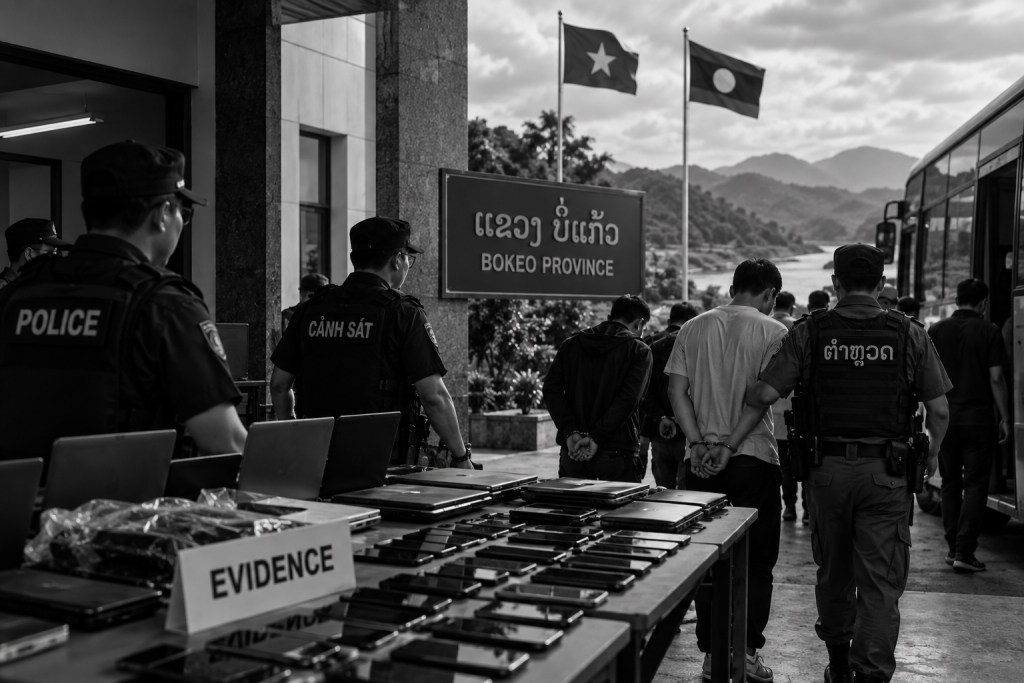
Vietnam Laos online fraud investigation procedures are under renewed attention after police from the two countries coordinated a raid on an alleged online task-fraud operation in Bokeo province, northern Laos.
The raid itself may have disrupted the operation.
But from an investigative perspective, that is only the beginning.
Once computers and mobile phones are seized, suspects cross a national border and thousands of potential victims need to be identified, investigators face a more difficult challenge:
How do you connect devices, operators, victims, bank accounts, payment flows and ultimate beneficiaries while preserving the evidential chain across jurisdictions?
On 12 September 2026, Vietnamese and Lao police conducted a coordinated operation in Bokeo that resulted in the arrest of 91 people — 64 Vietnamese citizens and 27 foreign nationals.
Authorities also seized 65 computers and 192 mobile phones.
Vietnam News reported that the 64 Vietnamese suspects and related exhibits were subsequently handed over to the Vietnamese authorities. Initial police enquiries allege that the operation had defrauded thousands of Vietnamese victims of more than VND1.5 trillion, approximately US$57 million, since early 2026. The investigation remained ongoing. (Vietnam News)
The Lao News Agency also reported the operation, although its account is attributed to the Vietnam News Agency and should therefore not be treated as fully independent corroboration.
No final judicial determination of guilt or definitive victim-loss figure had been established in the reviewed reporting.
The case nevertheless provides a useful example of why a successful raid is only one stage of a cross-border fraud investigation.
How the Alleged E-Commerce Task Fraud Worked
According to Vietnamese reporting, the alleged operators used social-media accounts to contact prospective victims.
Victims were then reportedly encouraged to perform online tasks such as placing orders through purported e-commerce platforms in exchange for commissions.
Police allege that the websites were fraudulent and that funds sent by victims were ultimately appropriated by the network.
This type of alleged scheme demonstrates why online fraud investigations often span several different investigative environments at once.
One case may involve:
- Social-media profiles
- Messaging applications
- Fake websites
- Mobile phones
- Computers
- Bank transfers
- E-wallets
- Mule accounts
- Corporate entities
- Different nationalities
- Victims in another jurisdiction
The challenge is therefore not simply identifying the office from which the operation allegedly worked.
Investigators need to reconstruct the entire operational chain.
For companies, legal teams and victims facing similar matters, professional fraud and investigation services may help establish the people, entities and assets connected with a suspected fraud.
Why the Vietnam Laos Online Fraud Investigation Matters
The most important feature of the Vietnam Laos online fraud investigation is arguably not the raid itself.
It is the handover.
The Vietnamese suspects and seized exhibits were transferred from Laos to Vietnam, where Lao Cai police said they would continue investigating and consolidating evidence.
That creates a fundamental investigative requirement:
evidential continuity.
A device seized in one country may later need to support legal proceedings in another.
Investigators therefore need to establish:
- Where the device was found
- Who seized it
- When it was seized
- Who had custody afterwards
- Whether it was altered
- How data was extracted
- Which suspect was associated with it
- Which accounts were accessed from it
- Which victims interacted with those accounts
Without that continuity, possessing the device may be far less useful than it first appears.
Step 1: Preserve the Devices
The reported seizure of 65 computers and 192 mobile phones creates a potentially significant digital evidence set.
But the number of devices alone says little about evidential value.
Investigators need to determine which devices matter and why.
A phone may contain:
- Social-media accounts
- Messaging histories
- Banking applications
- Cryptocurrency wallets
- Victim contact lists
- Photographs
- Login credentials
- Call records
- Location history
A computer may contain:
- Customer databases
- Fake e-commerce websites
- Payment records
- Staff schedules
- Scripts used to communicate with victims
- Account credentials
- Internal communications
The investigative objective is to link the digital evidence to people and actions.
Which operator used which device?
Which victims were contacted?
Which payments followed?
Where did the money go?
A pile of seized electronics becomes useful evidence only once those relationships can be established.
Step 2: Link Online Identities to Real People
Fraud networks rarely operate under their real names.
Investigators may encounter:
- Fake Facebook profiles
- False customer-service identities
- Disposable telephone numbers
- Messaging accounts
- Multiple email addresses
- False company names
- Nominee accounts
The challenge becomes one of entity resolution.
An investigator may need to establish that several apparently unrelated online identities were operated by the same individual.
That process can involve comparing:
- Telephone numbers
- Email addresses
- IP information
- Device identifiers
- Profile photographs
- Account recovery details
- Bank-account information
- Corporate records
- Known associates
Compliancia’s professional investigation services combine open-source research, local intelligence and investigative enquiries where online information alone does not provide a complete identity picture.
Step 3: Reconstruct the Victim Network
Vietnamese authorities initially alleged that thousands of Vietnamese victims had been affected.
Identifying those victims is not simply an administrative exercise.
Victim evidence can help reconstruct how the suspected operation worked.
Investigators may compare:
- Initial social-media contact
- Scripts used by operators
- Websites shown to victims
- Payment instructions
- Bank-account details
- Dates and amounts transferred
- Follow-up demands
- Telephone numbers
- Messaging accounts
Patterns can then emerge.
Multiple victims may have been directed to the same account.
Different operators may have used identical scripts.
The same phone number may connect several cases.
A corporate entity may appear repeatedly as a payment recipient.
Each connection strengthens the broader intelligence picture.
Step 4: Follow the Payment Chain
This is often where a fraud investigation becomes an asset-tracing investigation.
The account receiving money from a victim is not necessarily the final destination.
Fraud proceeds may move through several stages:
Victim → receiving account → mule account → intermediary → company or exchange → final beneficiary
Investigators therefore need to distinguish between:
- The first account receiving the funds
- Accounts used to move the money
- Accounts controlled by nominees
- Companies used in the payment chain
- Assets acquired using proceeds
- Individuals who ultimately benefited
This is why asset discovery and tracing can become relevant even while the underlying fraud investigation continues.
Identifying the first bank account is useful.
Identifying the ultimate beneficiary is considerably more valuable.
Compliancia has also previously examined how fraudsters in Southeast Asia move assets and how investigators trace them.
Step 5: Identify Mule Accounts and Intermediaries
Large-scale online fraud rarely depends on a single bank account.
Networks may require multiple accounts to receive and redistribute payments.
Some account holders may knowingly participate.
Others may have been recruited to provide access to their accounts.
Investigators therefore need to avoid assuming that every account holder has the same role.
Important questions include:
- Who opened the account?
- Who controlled online banking?
- Which telephone number was registered?
- Who received authentication codes?
- Where was the account accessed from?
- How quickly were funds moved?
- Did the holder retain a commission?
- Were several accounts linked to the same device or address?
The purpose is to reconstruct the hierarchy.
An effective investigation should distinguish between operators, intermediaries, mules, organisers and ultimate beneficiaries where the evidence supports those distinctions.
Step 6: Map the Organisations Behind the Individuals
Cross-border fraud investigations also require corporate and organisational mapping.
The people physically present at an operational site may represent only one layer of a wider network.
Investigators may therefore examine:
- Company registrations
- Directors
- Shareholders
- Beneficial owners
- Property leases
- Internet registrations
- Telephone subscriptions
- Payment processors
- Recruitment channels
- Related companies
- Local intermediaries
This can reveal connections that are difficult to see when suspects are reviewed individually.
Compliancia’s corporate investigation services include UBO and nominee detection, corporate mapping, online investigations and asset-recoverability assessments.
Step 7: Establish Who Controlled the Operation
Being physically present at a suspected scam site does not automatically establish a person’s role.
Investigators need to determine who exercised actual control.
Relevant evidence may include:
- Work schedules
- Supervisor messages
- Payment instructions
- Recruitment communications
- Access permissions
- Device administration
- Salary records
- Financial transfers
- Internal reporting structures
This helps answer a much more useful question than simply who was in the building:
Who directed the operation?
The answer may point to individuals elsewhere.
Step 8: Preserve Evidence Across Borders
Cross-border cases add another layer of difficulty.
Evidence gathered in Laos may be relevant to legal proceedings in Vietnam.
Bank accounts may be located in a third jurisdiction.
A platform may maintain records in another country.
A company connected with the payments may be registered elsewhere.
That creates questions around:
- Evidence transfer
- Chain of custody
- Mutual legal assistance
- Data preservation
- Witness availability
- Translation
- Authentication
- Local legal requirements
The September operation demonstrates how international cooperation can disrupt an alleged fraud network.
But the subsequent evidential work determines whether that disruption can support prosecutions, victim identification and potential recovery.
The VND1.5 Trillion Figure Requires Caution
Vietnam News and KPL reported an initial police estimate of more than VND1.5 trillion, or approximately US$57 million, in alleged losses.
That figure should currently be treated as an initial investigative estimate rather than a final judicially established loss.
Large fraud cases can contain several different financial numbers:
- Victim-reported losses
- Total incoming payments
- Money subsequently returned
- Attempted transactions
- Frozen funds
- Identified assets
- Recoverable assets
- Proven criminal proceeds
Those figures are not interchangeable.
Investigators therefore need to reconcile victim statements with transaction records before a reliable loss assessment can be made.
Disrupting a Scam Centre Is Only the First Step
A raid produces a visible result.
People are arrested.
Devices are seized.
An office is closed.
But the difficult work often begins afterwards.
Investigators must convert hundreds of devices, thousands of potential victim records and financial transactions into an intelligible evidential picture.
That means connecting:
Person → Device → Account → Victim → Payment → Asset → Beneficiary
If one of those links is missing, it may become difficult to understand the wider network.
This is particularly important in Southeast Asia, where fraud cases can quickly cross national borders.
What Private Investigators Can Add to a Cross-Border Fraud Case
Law-enforcement investigations and private investigations perform different functions.
Private investigators do not replace police powers.
However, companies, lawyers and victims may need additional intelligence concerning:
- Suspect identities
- Corporate structures
- Beneficial ownership
- Local addresses
- Business interests
- Associates
- Property
- Vehicles
- Litigation
- Bank-account intelligence where lawfully obtainable
- Asset recoverability
- Local source information
This can become particularly relevant when a victim needs to understand whether pursuing civil recovery is commercially realistic.
Compliancia’s asset discovery services focus on establishing what assets may exist and how they connect to individuals and companies.
Our broader investigation capabilities include fraud investigations, online and social-media investigations, source enquiries and corporate intelligence.
From Digital Evidence to Real-World Intelligence
Online fraud begins digitally.
But it does not remain entirely digital.
Operators work from physical locations.
Companies have directors.
Bank accounts have holders.
Vehicles have registered owners.
Property has ownership or occupancy histories.
Employees and associates know people.
The money eventually moves somewhere.
That is why effective fraud intelligence often combines digital research with human and real-world investigation.
Open-source intelligence may identify an account.
Corporate records may identify a company.
A source enquiry may clarify who actually controls it.
A site visit may determine whether the business exists at the claimed address.
Asset enquiries may identify where value ultimately accumulated.
Each layer can corroborate another.
Cross-Border Fraud Investigations in Southeast Asia
Compliancia supports law firms, corporate counsel, companies and selected private clients with investigative intelligence across Southeast Asia.
Relevant capabilities include:
- Fraud investigations
- Cross-border investigative intelligence
- Online and social-media investigations
- Entity and identity mapping
- Source enquiries
- Corporate intelligence
- Beneficial ownership research
- UBO and nominee detection
- Asset discovery and tracing
- Litigation support
- Evidence gathering
- Local field enquiries
Our approach combines OSINT, corporate records, document analysis, source enquiries and on-the-ground investigation.
In a complex fraud matter, the objective is not simply to find more data.
It is to connect the evidence:
Who operated the scheme?
Which devices did they use?
Which victims were contacted?
Where were payments sent?
Which accounts moved the funds?
Which entities sit behind those accounts?
And who ultimately benefited?
Learn more about Compliancia’s investigation services, our asset discovery capabilities or Compliancia’s Southeast Asia investigation experience.
Editorial Note
This article discusses an ongoing investigation based on reporting published on 17-18 September 2026.
The arrests and seizure of devices should not be interpreted as proof of guilt by any individual.
Descriptions of the alleged operation, victim numbers and financial losses reflect initial information attributed to Vietnamese authorities and subsequently reported by Vietnam News.
The Lao News Agency report substantially attributes its account to the Vietnam News Agency and therefore provides limited independent corroboration.
The reported VND1.5 trillion loss figure remains an initial investigative estimate in the reviewed reporting. The investigation was continuing, and legal proceedings had not yet established final guilt, responsibility or loss.