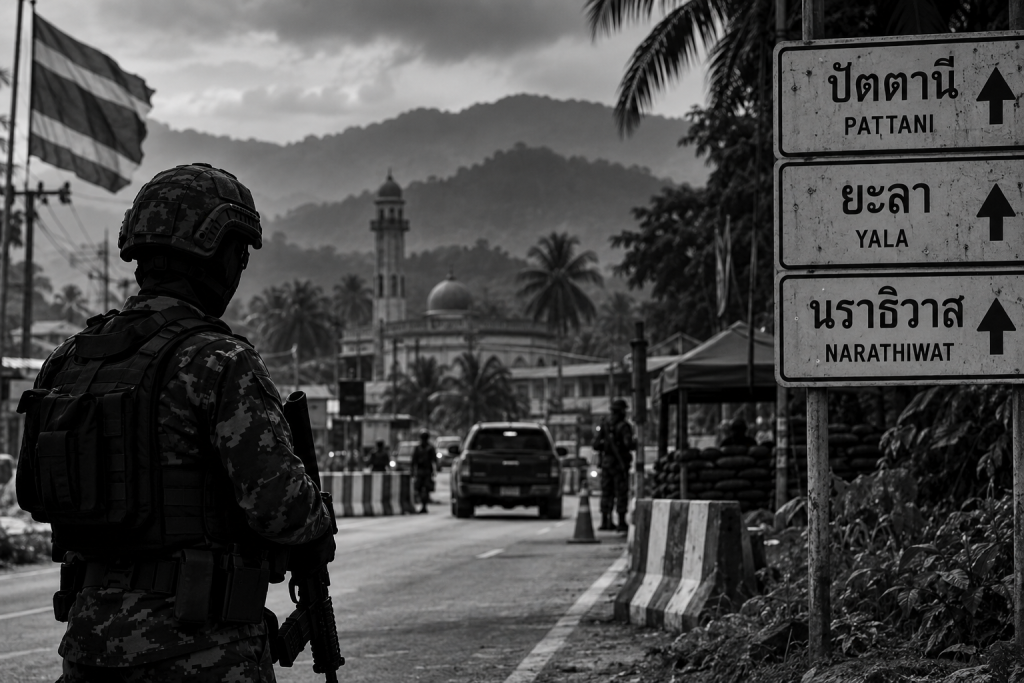
Southern Thailand Security Risk: 7 Critical Considerations for Companies and Travellers
Southern Thailand Security Risk remains an important consideration for companies, investors, legal teams, travellers and organisations operating near Thailand’s southern border.
The long-running conflict in Pattani, Yala and Narathiwat, together with parts of southern Songkhla, has continued despite years of negotiations and peace initiatives.
A recent Nikkei Asia analysis, Thailand’s Deep South: The Peace That Never Came, examines why efforts to achieve a durable settlement have repeatedly struggled against deep-rooted grievances, mistrust and continuing violence.
Read the Nikkei Asia analysis on Thailand’s Deep South
For organisations operating in the region, the key issue is not simply understanding the political history.
It is understanding how an evolving security environment can affect people, operations, travel, assets and decision-making.
Table of Contents
- Why Southern Thailand Security Risk Still Matters
- Violence Has Continued Despite Peace Talks
- Understand Geographic Risk
- Monitor Political and Security Developments
- Assess Travel and Movement Risk
- Protect Personnel and Executives
- Verify Local Partners and Networks
- Prepare for Rapid Changes in the Security Environment
- How Compliancia Can Help
Why Southern Thailand Security Risk Still Matters
Southern Thailand Security Risk has persisted for decades, particularly in the Malay Muslim-majority provinces of Pattani, Yala and Narathiwat.
The conflict involves separatist violence, security operations, political grievances and a long-running effort to establish meaningful dialogue between the Thai state and insurgent groups.
Peace negotiations have continued, but violence has not disappeared.
As of late August 2026, Thai officials were preparing for another round of talks with representatives of the Barisan Revolusi Nasional, or BRN, expected in Malaysia in late September. Thailand’s chief peace negotiator said the discussions would focus on reducing violence and potentially establishing safety zones, while also warning against unrealistic expectations.
This distinction is important.
Dialogue may be progressing while the security environment remains unstable.
For companies and individuals, Southern Thailand Security Risk therefore requires continuous assessment rather than a one-time review.
Recent Violence Shows Why Risk Monitoring Matters
The recent security environment illustrates how quickly conditions can change.
In August 2026, Thai PBS reported a wave of coordinated arson and bombing incidents across more than 50 sites in Thailand’s Deep South, following an earlier ambush that killed five soldiers.
These incidents occurred while authorities were simultaneously preparing for renewed peace talks.
That creates an important risk-management lesson:
Political dialogue does not automatically mean operational stability.
An organisation relying solely on national-level political developments may therefore underestimate conditions on the ground.
Effective Southern Thailand Security Risk assessment should combine:
- Political monitoring
- Local intelligence
- Incident analysis
- Route assessment
- Site-specific risk
- Threat intelligence
- Personnel exposure
- Contingency planning
Compliancia’s investigation and security services in Thailand combine intelligence gathering, risk assessment and local investigative capabilities to help clients understand complex environments.
1. Southern Thailand Security Risk Is Highly Geographic
Risk in Thailand is not uniform.
Bangkok, Phuket, Chiang Mai and Pattaya do not present the same security environment as the southern border provinces.
The UK Foreign, Commonwealth & Development Office currently advises against all but essential travel to:
- Pattani Province
- Yala Province
- Narathiwat Province
- Chana district in Songkhla
- Thepa district in Songkhla
- Na Thawi district in Songkhla
- Saba Yoi district in Songkhla
The advice also covers the Hat Yai–Padang Besar train line through affected areas.
Read the UK Government regional risk guidance for Thailand
For companies, this means risk assessments should be location-specific.
A business trip to Hat Yai may require a different security posture from travel into rural Narathiwat.
A project near Pattani may require different movement procedures from an assignment in central Songkhla.
2. Understand the Nature of the Threat
Southern Thailand Security Risk is not limited to one type of incident.
Security threats in the region have historically included:
- Bombings
- Arson
- Ambushes
- Attacks on security personnel
- Attacks on government facilities
- Infrastructure incidents
- Targeted shootings
- Disruption to transport
The UK government currently warns that attacks occur regularly in the southern provinces near Malaysia and notes that targets can include security forces, government offices, hotels, shops and transport infrastructure.
Read the UK Government’s Thailand safety and security guidance
The practical implication is that companies should not only ask:
“Is this province considered dangerous?”
They should ask:
“What specific threats could affect our people, routes, hotels, meetings or operations?”
This is where intelligence-led security planning becomes more useful than generic travel advice.
3. Monitor Political and Peace-Talk Developments
Security analysis should also consider the political environment.
The peace process remains active.
In April 2026, Thailand appointed a new chief negotiator to lead southern peace talks and sought increased Malaysian cooperation.
By August, preparations were underway for another round of discussions with BRN representatives, with violence reduction and possible safety zones expected to be key topics.
The continuation of dialogue is important.
However, it should not be interpreted as proof that local risks have disappeared.
Companies should monitor:
- Changes in negotiation leadership
- BRN statements
- Thai government policy
- Malaysian facilitation
- Ceasefire proposals
- Local reactions
- Significant security incidents
- Changes in emergency or martial-law measures
A strong Southern Thailand Security Risk assessment combines political developments with local operational intelligence.
4. Travel Planning Should Be Intelligence-Led
Travelling through a higher-risk region requires more than checking a map.
Movement planning may need to consider:
- Route selection
- Time of travel
- Road conditions
- Recent security incidents
- Checkpoints
- Alternative routes
- Communication coverage
- Emergency medical access
- Vehicle reliability
- Driver familiarity
- Local security presence
Compliancia’s close protection services in Thailand use pre-travel risk analysis, threat intelligence, advance visits and route planning to reduce exposure before movements occur.
For higher-risk travel, the question should not simply be:
“Can we drive there?”
It should be:
“What is the safest way to move, and what is our fallback if conditions change?”
5. Southern Thailand Security Risk Requires Personnel Planning
Companies have a duty to understand the environment in which employees or executives are being asked to operate.
For senior executives, lawyers, journalists, investors, consultants or other high-profile visitors, visibility may increase exposure.
Security planning can therefore include:
- Threat assessment
- Secure transportation
- Hotel assessment
- Meeting-location assessment
- Advance reconnaissance
- Communication planning
- Emergency protocols
- Medical contingencies
- Protective personnel where justified
Compliancia’s protection services use intelligence gathering, advance visits, threat analysis and environment mapping before clients enter higher-risk situations.
This approach is especially relevant where travel is necessary despite elevated regional risk.
6. Verify Local Partners and Relationships
Security risks are not always physical.
Operating in politically sensitive or contested areas can create additional reputational and relationship risks.
Companies may work with:
- Local contractors
- Transport providers
- Landowners
- Community representatives
- Government contacts
- Suppliers
- Security personnel
- Intermediaries
Before relying heavily on an unfamiliar local partner, companies should understand who they are dealing with.
An investigation may examine:
- Ownership
- Political connections
- Reputation
- Criminal background
- Business history
- Undisclosed relationships
- Local influence
- Potential conflicts
Compliancia’s investigation services in Thailand include business-partner investigations, background checks, UBO identification, corporate mapping and reputation enquiries.
Where local relationships are important to operational security, background intelligence can provide valuable context.
7. Local Intelligence Can Matter More Than National Headlines
A major limitation of generic risk reports is that they can lag behind events.
National news may describe broad political developments.
Local intelligence can explain what is changing on the ground.
This might include:
- Increased security presence
- Road closures
- Local tension
- Changes in community sentiment
- Recent attacks
- Planned demonstrations
- Localised threats
- Disruption to transport
- Changes in police or military posture
Compliancia’s investigative model relies on local sources, open-source intelligence and on-the-ground information gathering to help clients understand situations that may not be fully explained by public reporting.
That can be particularly important in environments where conditions change quickly.
Peace Talks Do Not Eliminate Security Risk
The continuing dialogue between the Thai government and BRN is significant.
It indicates that both security and political channels remain active.
However, Thai officials themselves have cautioned against expecting rapid results from the next round of negotiations, especially after recent violence.
This means companies should avoid interpreting peace-talk announcements as immediate changes to operational risk.
A durable settlement may require progress on:
- Political grievances
- Local governance
- Security guarantees
- Trust between parties
- Community participation
- Violence-reduction mechanisms
Until the environment changes materially, organisations operating in affected provinces should continue treating Southern Thailand Security Risk as an active issue.
Security Risk Also Affects Business Continuity
Violence does not need to target a company directly to affect operations.
Indirect impacts may include:
- Staff unable to travel
- Delayed deliveries
- Road closures
- Increased insurance restrictions
- Cancelled meetings
- Project interruptions
- Security-related costs
- Difficulty recruiting personnel
- Reputation concerns
- Client hesitation
This means regional security should be integrated into business-continuity planning.
A company working in Southern Thailand should understand not only how to protect staff but also how an incident could interrupt commercial operations.
How Compliancia Assesses Southern Thailand Security Risk
Compliancia supports businesses, law firms, investors and selected private clients with investigations, protective intelligence and security planning throughout Thailand.
Depending on the assignment, support can include:
- Security risk assessment
- Threat intelligence
- Local intelligence gathering
- Political and security monitoring
- Advance site visits
- Route reconnaissance
- Executive protection
- Security drivers
- Background investigations
- Local-partner verification
- Corporate intelligence
- Source enquiries
- Incident investigation
- On-the-ground verification
Compliancia’s executive security services specifically integrate intelligence gathering, threat-level assessment and tailored security planning before protective deployments.
Our broader protection services include advance visits, route planning, threat analysis and discreet protective support.
For investigative matters, our Thailand investigation team can conduct local source enquiries, background research and evidence gathering.
Southern Thailand Security Risk: Information Before Movement
Thailand’s Deep South remains a complex environment.
Peace talks continue.
So does violence.
For organisations with employees, projects, investments or travel requirements in Pattani, Yala, Narathiwat or nearby parts of Songkhla, security planning should therefore be based on current intelligence rather than assumptions.
Understand the location.
Understand the threat.
Understand who you are dealing with.
Plan movements carefully.
Monitor changes continuously.
The objective is not to avoid every challenging environment.
It is to understand the environment well enough to make informed decisions.
Speak With Compliancia About Southern Thailand Security Risk
Planning travel, operations or a project in Southern Thailand?
Compliancia provides confidential risk assessments, threat intelligence, investigations and protective support throughout Thailand.
Contact wecare@compliancia.com for a confidential case consultation.