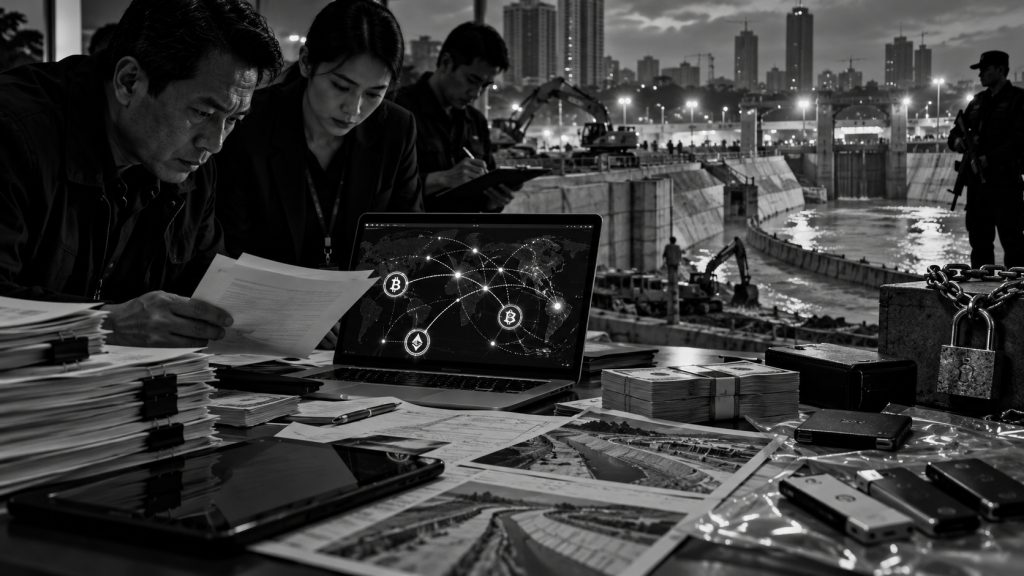
Philippines Crypto Asset Tracing: What a Freeze Order Can and Cannot Prove
Philippines crypto asset tracing has become increasingly relevant to corruption and financial investigations as money moves between conventional bank accounts, companies, intermediaries and virtual-asset platforms.
A September 2026 Court of Appeals freeze order illustrates the challenge.
According to the Anti-Money Laundering Council (AMLC), the order covered 86 bank accounts, four investment accounts, one insurance policy and 25 virtual-asset wallets associated with a lawmaker, a corporation and related individuals and entities in an investigation involving alleged flood-control anomalies and a wider budget-kickback scheme.
The Court of Appeals issued the order on 21 September 2026 after finding probable cause for the purposes of the freeze proceedings that the assets were related to alleged plunder.
That finding is significant.
But its meaning should not be overstated.
A freeze order is a preservation measure.
It prevents property from being transferred or dissipated while an investigation and subsequent legal process continue. It does not itself establish a criminal conviction, beneficial ownership of every asset, or completed recovery.
For investigators and legal teams, the case demonstrates a broader principle:
Identifying a wallet or bank account is only the beginning. The real challenge is connecting the asset to the person who controls it, reconstructing where the value came from and determining where it was intended to go.
What Did the September Freeze Order Cover?
The reported order covered several different types of financial property:
-
86 bank accounts
-
Four investment accounts
-
One insurance policy
-
25 virtual-asset wallets
According to AMLC information quoted by GMA News, the financial investigation identified movements through intermediaries, corporations, bank accounts, a money-service business and a virtual-asset platform.
The AMLC said that using multiple recipients and financial channels increased the transactional distance between the funds and their alleged source.
The Philippine Star similarly reported that virtual-asset service providers and multiple wallets formed part of the alleged movement of funds.
This creates a useful example of multi-channel asset tracing.
Investigators are no longer necessarily following a simple sequence such as:
Bank A → Bank B
The trail may instead involve:
Bank account → Corporation → Intermediary → Money-service business → Virtual-asset platform → Wallet → Second wallet
Every additional step can make ownership and purpose more difficult to establish.
Why Philippines Crypto Asset Tracing Matters
The importance of Philippines crypto asset tracing is not that cryptocurrency is inherently suspicious.
It is not.
Virtual assets are increasingly part of legitimate financial activity, and the Philippines maintains a regulatory framework for virtual-asset service providers.
The Bangko Sentral ng Pilipinas requires supervised institutions dealing with VASPs to apply appropriate due diligence and risk-management controls. Its 2026 guidance specifically emphasises counterparty verification and enhanced due diligence where necessary.
BSP guidance on virtual-asset service providers
The investigative challenge arises when digital assets form part of a larger chain that may also involve conventional financial institutions, companies and individuals.
A cryptocurrency transaction can be visible on a blockchain while the identity behind a wallet remains unclear.
That creates two different questions:
Where did the value move?
and
Who controlled the wallet when it moved?
Those questions are related, but they are not identical.
Step 1: Identify the Wallet
The first task may be simply establishing the relevant wallet address.
That information can potentially reveal transaction history, including:
-
Incoming transfers
-
Outgoing transfers
-
Timing
-
Amounts
-
Interacting wallets
Blockchain records may therefore provide useful investigative leads.
But a wallet address is not the same as a person’s name.
Investigators still need to attribute the wallet.
That can require connecting blockchain information with:
-
Exchange records
-
Mobile devices
-
Emails
-
Telephone numbers
-
Login information
-
Bank transfers
-
Corporate accounts
-
Witness evidence
The investigation becomes an identity problem as much as a financial problem.
Step 2: Connect Fiat Money to Virtual Assets
Many investigations involve movement between conventional currency and virtual assets.
A simplified chain might look like:
Bank account → Crypto exchange → Wallet
or:
Company → Money-service business → Virtual-asset platform → Wallet
Investigators therefore need to establish where the money entered the virtual-asset ecosystem.
Relevant evidence can include:
-
Bank transfers
-
Exchange records
-
Deposit references
-
Know-your-customer information
-
Account registration
-
Device information
-
Transaction timestamps
If a bank transfer of ₱5 million reaches an exchange account and a cryptocurrency purchase follows minutes later, that timing may be relevant.
But investigators should still establish whether the transactions are actually connected rather than assuming causation from chronology alone.
Step 3: Identify the Controller
A wallet may technically belong to one person while being controlled by another.
The same issue occurs with bank accounts.
Investigators should therefore ask:
-
Who created the account?
-
Who possessed the credentials?
-
Which device accessed it?
-
Who authorised transfers?
-
Who received authentication codes?
-
Did another person provide instructions?
This is particularly important where nominees or intermediaries may be involved.
A registered account holder can provide an important investigative lead without necessarily representing the ultimate beneficiary.
Compliancia’s investigation services include beneficial-ownership research, corporate mapping and asset investigations designed to identify relationships behind formal ownership records.
Step 4: Map the Intermediaries
The AMLC’s description of the September case is notable because it referred to the use of multiple intermediaries and financial channels.
Intermediaries can include:
-
Individuals
-
Companies
-
Money-service businesses
-
Virtual-asset platforms
-
Nominee account holders
-
Related entities
The existence of an intermediary does not itself demonstrate wrongdoing.
Investigators need to determine why that person or entity appears in the chain.
Questions may include:
What service did they provide?
Why did they receive the money?
Did they retain any portion?
Did they immediately transfer it onwards?
Are they connected to other parties in the investigation?
This is where corporate investigations and transaction analysis often need to operate together.
Step 5: Follow the Wallet-to-Wallet Movement
Virtual assets can move through several wallets very quickly.
A simplified structure may look like:
Wallet A → Wallet B → Wallet C → Exchange
The blockchain may preserve evidence that these transfers occurred.
But the investigative question remains:
Why did they occur?
Multiple transfers could potentially reflect:
-
Normal investment activity
-
Custody arrangements
-
Internal exchange movements
-
Commercial payments
-
Attempts to separate funds from their original source
The transaction pattern is evidence.
Its interpretation requires context.
This distinction matters because investigators should not equate complexity with money laundering automatically.
Step 6: Connect the Crypto Trail Back to Real-World Assets
Virtual assets may eventually be converted back into conventional currency.
Funds might then be used to acquire:
-
Property
-
Vehicles
-
Securities
-
Company shares
-
Luxury assets
At this stage, crypto tracing begins to overlap with traditional asset discovery and tracing.
The relevant chain may become:
Alleged source → Bank → Crypto platform → Wallets → Exchange → Bank → Property
The more of that sequence investigators can independently establish, the more useful the evidence becomes for lawyers considering preservation or recovery options.
A Freeze Order Is Not a Finding of Guilt
This is the most important legal distinction in the September case.
Under Philippine anti-money-laundering legislation, the Court of Appeals may issue a freeze order after determining that probable cause exists that monetary instruments or property are related to unlawful activity.
The amended framework provides for an initial freeze period followed by a hearing on whether the order should be modified, lifted or extended.
Republic Act No. 10927 – amendments concerning freeze orders
That standard allows property to be preserved while legal proceedings continue.
It does not mean the court has already determined beyond reasonable doubt that:
-
The lawmaker committed the alleged offence
-
Every account holder knowingly participated
-
Every frozen asset represents criminal proceeds
-
The property has been forfeited
-
The government has recovered its value
Those questions require further proceedings and evidence.
Freezing Is Not Recovery
The distinction is similar to the one raised by the broader Philippine flood-control asset investigation.
The process can be viewed as:
Identify → Trace → Freeze → Establish ownership → Prove connection → Forfeit → Realise → Recover
A freeze sits relatively early in that chain.
Its principal purpose is preservation.
If an account contains value today but the funds can disappear tomorrow, investigation becomes far less useful.
Preservation therefore creates time.
But it does not complete the recovery process.
This is why a statement such as:
“Authorities recovered assets from 25 crypto wallets”
would be inaccurate based on the current reporting.
A more precise statement is:
The Court of Appeals ordered the wallets and other financial assets frozen while the investigation continues.
Crypto Does Not Make Assets Invisible
One misconception is that cryptocurrency makes financial tracing impossible.
In many cases, the opposite problem exists.
Public blockchain transactions can create a persistent record.
The challenge lies in attribution.
Investigators may be able to observe:
Wallet A sent value to Wallet B
without immediately knowing who controls either wallet.
That is why effective crypto asset tracing may require combining:
-
Blockchain analysis
-
Exchange records
-
Bank records
-
Corporate research
-
Device evidence
-
Source enquiries
-
Beneficial-ownership analysis
The blockchain can provide the route.
Traditional investigative techniques may still be necessary to identify the people behind it.
Why Virtual-Asset Platforms Matter
Regulated virtual-asset platforms can become important points in an investigation because customers may be subject to identification and due-diligence requirements.
The BSP’s VASP framework treats virtual-asset service providers as part of the regulated financial environment and imposes AML and risk-management requirements.
In 2026, the BSP also reminded supervised financial institutions that they should deal only with appropriately authorised virtual-asset providers and apply enhanced due diligence when risks justify it.
This creates potential points where digital and conventional financial intelligence intersect.
A wallet may appear pseudonymous.
An exchange account associated with that wallet may contain identifying information.
What Legal Teams Should Ask in a Crypto-Linked Asset Investigation
When virtual assets appear in a fraud, corruption or recovery matter, counsel may want investigators to answer several distinct questions.
Which wallets are relevant?
Identify the addresses and transaction history.
Who appears to control them?
Connect digital identifiers with individuals or companies.
How did value enter the wallets?
Trace the fiat-to-crypto conversion where possible.
Where did the value move next?
Map downstream wallets and platforms.
Did funds return to the banking system?
Identify conversion or withdrawal points.
Are companies or nominees involved?
Investigate beneficial ownership and related entities.
What assets can ultimately be identified?
Establish whether value appears to have been converted into property, companies or other recoverable assets.
This is fundamentally a link-analysis exercise.
Traditional Asset Tracing Still Matters
Crypto analysis should not replace ordinary investigative work.
A subject may simultaneously hold:
-
Virtual assets
-
Bank accounts
-
Property
-
Companies
-
Vehicles
-
Investments
The most useful investigation therefore looks at the whole financial picture.
Compliancia’s asset discovery services combine asset research with corporate ownership and cross-border enquiries where counsel needs to understand what a subject appears to own or control.
Our broader investigation capabilities include:
-
Fraud investigations
-
Corporate-link analysis
-
Beneficial-ownership research
-
UBO and nominee detection
-
Source enquiries
-
Evidence gathering
-
Asset tracing
-
Litigation support
-
Cross-border investigative intelligence
The objective is not simply to identify a wallet address.
It is to understand the people, companies and assets behind the transaction chain.
From Wallet Address to Recoverable Asset
The September Philippine freeze order provides a useful illustration of modern asset tracing.
Investigators may need to move between:
Banks → Investment accounts → Insurance → Companies → Money-service businesses → Crypto platforms → Wallets
No single database provides the complete answer.
And no single transaction necessarily proves criminal conduct.
The investigative value comes from linking those different layers into a coherent, corroborated sequence.
For lawyers considering recovery, the ultimate questions remain familiar:
Where did the money come from?
Who controlled it?
Where did it move?
Who ultimately benefited?
What assets still exist?
And what evidence connects those assets to the underlying conduct?
Technology changes the route.
It does not change the fundamental purpose of asset tracing.
How Compliancia Supports Cross-Border Asset Investigations
Compliancia provides investigative intelligence to law firms, companies and counsel handling complex matters across Southeast Asia.
Relevant capabilities include:
-
Financial-link analysis
-
Corporate investigations
-
Beneficial-ownership mapping
-
UBO and nominee detection
-
Source enquiries
-
Fraud investigations
-
Cross-border research
-
Evidence gathering
-
Litigation support
In matters involving digital assets, the investigative question should not stop at:
“Which wallet received the money?”
The more valuable questions are:
Who controlled that wallet?
What happened before the funds reached it?
Where did the assets move afterwards?
Which companies or intermediaries appear in the chain?
And what ultimately remains available for preservation or recovery?
That is the difference between locating a transaction and understanding the financial network behind it.
Editorial Note
This article discusses a Court of Appeals freeze order dated 21 September 2026, publicly reported on 1–2 October 2026.
According to reporting based on information from the Anti-Money Laundering Council, the order covers 86 bank accounts, four investment accounts, one insurance policy and 25 virtual-asset wallets linked by investigators to a lawmaker, a company and associated parties in connection with alleged flood-control anomalies and a broader alleged budget-kickback scheme.
The AMLC did not publicly identify the lawmaker in the reports reviewed for this article. This article therefore does not speculate about the person’s identity.
The freeze order reflects a judicial finding of probable cause for the purposes of restraining the relevant assets. It does not constitute a criminal conviction, final forfeiture order or completed asset recovery.
Descriptions of alleged corruption, plunder, fund movements and connections among parties reflect information attributed to AMLC and the ongoing investigation.
Primary reporting: GMA News and The Philippine Star.
For the applicable anti-money-laundering framework, see the Anti-Money Laundering Council and Republic Act No. 10927.