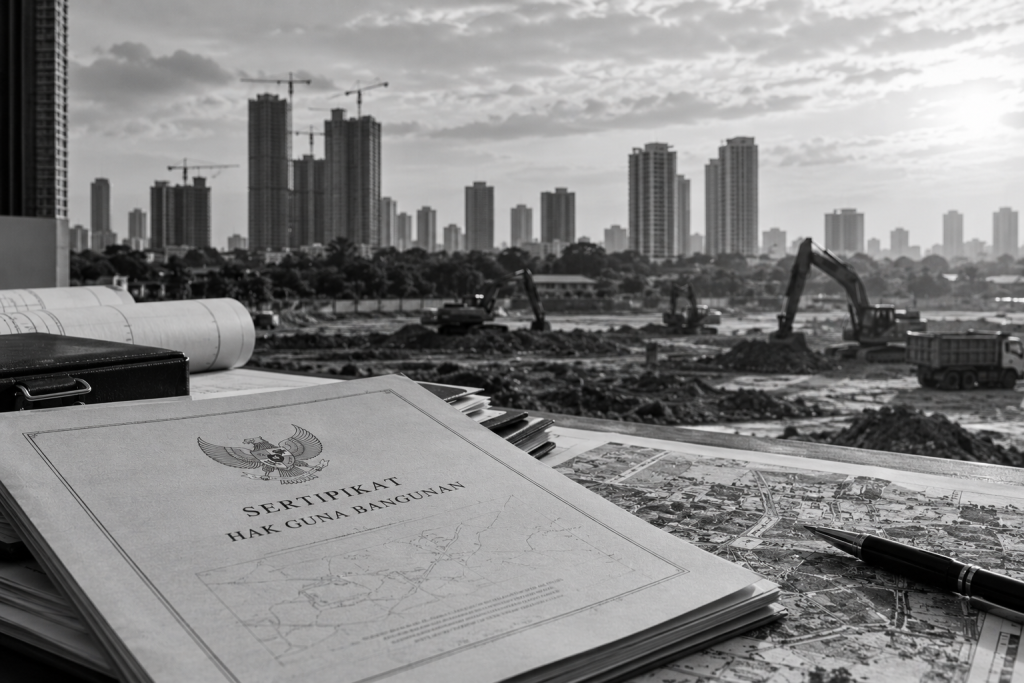
Indonesia Land Due Diligence: Who Really Sits Behind a Land Approval?
Indonesia land due diligence should not stop with a land certificate.
A September 2026 corruption investigation involving building-use rights in Bogor, West Java, illustrates why companies and investors may also need to understand who facilitated an approval, who communicated with officials, who received payments and whether informal intermediaries operated around the formal process.
Indonesia’s Corruption Eradication Commission, known as the KPK, detained eight people in September in an ongoing investigation concerning alleged bribery linked to the processing of building-use rights, or Hak Guna Bangunan (HGB), connected with property developer PT Summarecon Agung Tbk. The defendants include company representatives and government officials. The allegations remain under investigation and should not be treated as findings of guilt.
Reuters reported that investigators also seized electronic evidence and cash in Indonesian rupiah and foreign currencies worth approximately Rp106.3 billion, or about US$6 million. The KPK said it was continuing to investigate the origin and intended use of the seized funds.
The more important due-diligence lesson emerged during follow-on reporting.
KPK investigators said they were examining a possible network of intermediaries outside the formal structure of the Ministry of Agrarian Affairs and Spatial Planning/National Land Agency, or ATR/BPN. The KPK described this as a possible “shadow” structure through which individuals outside the ministry allegedly had access to land-related processes. This remains an investigative theory, not an established institutional finding.
For companies considering property transactions in Indonesia, the question is therefore broader than:
Is the title valid?
It should also include:
Who helped obtain, extend, unblock or modify the underlying land rights — and what relationships or payments sat behind that process?
What Is Being Investigated?
The investigation concerns the handling of HGB rights connected with land managed by Summarecon in Bogor Regency.
Reuters reported that the matter involved an application relating to the extension of right-to-build title over land managed by the developer. The KPK launched the investigation after receiving allegations of corruption involving officials at ATR/BPN.
ANTARA subsequently reported that investigators searched offices within the ministry and seized further evidence while investigating alleged corruption surrounding the land rights.
Documents and electronic material were also seized during a search of Summarecon’s office, including HGB-related documents and financial records connected with the property project.
These investigative steps do not establish liability.
They do, however, show why Indonesia land due diligence must examine both the formal administrative record and the network of people surrounding it.
For companies facing similar questions, Compliancia’s corporate investigation work includes ownership research, source enquiries, UBO and nominee detection and land-related intelligence. Compliancia Investigation Services
A Land Certificate Tells Only Part of the Story
The starting point in most land due diligence is documentation.
Lawyers and investors may examine:
- HGB or other applicable land rights
- Registered holder
- Expiry dates
- Encumbrances
- Mortgages
- Boundaries
- Planning permissions
- Litigation
- Restrictions on use
All of this is essential.
But a land certificate does not necessarily show how an approval was obtained.
It will not usually identify:
- Who introduced the applicant to officials
- Who managed communications
- Whether informal consultants were involved
- Who requested accelerated processing
- Whether payments were made through third parties
- Whether officials acted outside normal procedure
That is where conventional legal due diligence and investigative due diligence begin to diverge.
Legal records explain the formal position.
Investigative intelligence tries to establish what happened around the formal process.
Indonesia Land Due Diligence Question 1: Who Is the Intermediary?
Intermediaries are not inherently suspicious.
Land transactions routinely involve:
- Lawyers
- Notaries
- Consultants
- Surveyors
- Brokers
- Government-relations advisers
- Property agents
- Local representatives
The problem is not the existence of an intermediary.
The problem arises when a company cannot clearly explain:
Who the intermediary is, what they actually do and why they are being paid.
A robust counterparty review should establish:
- Full legal identity
- Corporate ownership
- Directors
- Beneficial owners
- Professional background
- Government relationships
- Previous projects
- Litigation
- Adverse media
- Reputation among local sources
Where the intermediary is an individual rather than a company, investigators may need to examine employment history, affiliations and relationships with relevant decision-makers.
This is precisely where enhanced counterparty research can go beyond a standard database search.
Compliancia Company Due Diligence
Question 2: What Was the Intermediary Actually Paid For?
The description on an invoice may not provide the full answer.
Terms such as:
consulting fee
success fee
project support
government relations
or
administrative assistance
can cover legitimate services.
They can also be too vague to explain what work was actually performed.
Investigators should therefore compare payment records with:
- Contracts
- Scope of work
- Deliverables
- Correspondence
- Meeting records
- Internal approvals
- Payment dates
- Administrative milestones
For example:
Intermediary appointed → payment made → land restriction removed
does not establish wrongdoing.
But that sequence may justify further questions about what service was provided and who participated in the decision.
Question 3: Who Introduced Whom?
Introductions can be highly significant in land-related investigations.
A company may believe it is dealing with an ordinary consultant.
But the consultant may have:
- Political relationships
- Family relationships with officials
- Previous government employment
- Business partnerships with decision-makers
- Informal access to a ministry or land office
The KPK’s current investigation is relevant precisely because investigators say they are examining individuals outside the ministry who may nevertheless have had access to land-processing activities.
That does not mean every connected intermediary is improper.
It means their relationships should be understood.
A useful due-diligence question is:
Why was this particular intermediary selected?
If the answer is simply:
“They know the right people,”
additional investigation may be warranted.
Question 4: Who Controls the Counterparty?
A company name alone tells investigators very little.
An intermediary company may be owned by another company.
That company may have nominee shareholders.
Its directors may have relationships with officials or developers involved elsewhere in the transaction.
Investigators therefore need to examine beneficial ownership.
This may include:
- Direct shareholders
- Indirect shareholders
- Related companies
- Nominee arrangements
- Directors
- Family connections
- Common addresses
- Shared telephone numbers
- Previous corporate affiliations
Compliancia’s investigation services include corporate mapping, UBO and nominee detection, foreign asset searches and business-partner investigations.
Corporate Investigation and UBO Research
Question 5: Does the Transaction Timeline Make Sense?
Chronology is one of the most useful tools in a corruption or due-diligence investigation.
Investigators may reconstruct:
Day 1: Land-right application encounters difficulty
Day 10: Consultant is introduced
Day 20: Consulting agreement signed
Day 22: Payment made
Day 30: Meeting with officials
Day 45: Administrative restriction removed
That hypothetical chronology does not prove misconduct.
But it allows investigators to identify the key events that require explanation.
The KPK has said that its current investigation is examining both alleged payment flows and the chain of command behind relevant land-processing decisions.
This demonstrates why transaction reconstruction can be as important as ownership research.
Question 6: Does the Consultant Have Real Operations?
A registered company may look legitimate on paper.
Investigators should still ask whether it actually operates.
Potential checks include:
- Office verification
- Employees
- Website history
- Business activities
- Previous clients
- Financial filings
- Telephone numbers
- Professional registrations
- Physical presence
A discreet site visit can sometimes establish more than pages of online records.
For example:
Is the supposed consultancy operating from a genuine office?
Or is its registered address a residential unit with no obvious business activity?
Compliancia’s wider investigation services include discreet source enquiries, property investigations and covert site visits when documentary research alone cannot establish the operational reality.
Question 7: Follow the Payment Beyond the Intermediary
The first recipient of a payment is not necessarily its final beneficiary.
Money may move from:
Developer → Consultant → Related company → Individual
or:
Company → Intermediary → Cash withdrawal
or:
Company → Consultant → Another adviser
This is where transaction reconstruction begins to overlap with asset and financial intelligence.
Investigators may examine:
- Related companies
- Beneficial owners
- Property
- Business interests
- Connected individuals
- Financial relationships
The objective is not merely to identify where money was first paid.
It is to establish where value ultimately went.
Where a dispute develops into an asset issue, further asset tracing may also become relevant.
Compliancia Asset Discovery Services
Why Source Enquiries Matter
Some questions cannot be answered through documents alone.
Corporate databases may identify a director.
They may not explain that person’s actual influence.
A consultant’s website may claim substantial experience.
It may not reveal how the person is perceived locally.
Source enquiries can help establish:
- Industry reputation
- Informal relationships
- Operational role
- History with government agencies
- Whether claimed expertise is genuine
- Whether a person appears to act for undisclosed parties
This does not mean rumours should be treated as evidence.
Source intelligence needs to be assessed for credibility and corroborated wherever possible.
Compliancia uses discreet source enquiries alongside corporate research and open-source intelligence when clients need to understand relationships that are not apparent from official records.
Land Corruption Risk Is Not a New Governance Question
The current investigation sits within a broader land-governance challenge.
In August 2026, the KPK publicly called on ATR/BPN to strengthen integrity controls in land services and emphasised the need for transparent and accountable processes.
Earlier KPK analysis of land certification processes had also identified weaknesses in monitoring, complaint handling and oversight around HGB and other land-right processes.
These findings do not imply corruption in every Indonesian land transaction.
They do explain why investors should avoid treating formal documentation as the only layer of risk analysis.
A Practical Indonesia Land Due Diligence Checklist
Before entering a significant property or development transaction, investors and counsel may want to test five separate layers.
1. Title
Confirm:
- Registered rights
- Holder
- Boundaries
- Expiry
- Encumbrances
- Disputes
2. Approval History
Establish:
- Applications
- Amendments
- Extensions
- Planning permissions
- Blockages
- Administrative decisions
3. Counterparties
Investigate:
- Seller
- Developer
- Joint-venture partners
- Consultants
- Brokers
- Local representatives
4. Intermediaries
Determine:
- Who introduced them
- What service they provide
- How they are paid
- Who owns them
- Which officials they know
5. Payment Flow
Reconstruct:
- Amount
- Timing
- Recipient
- Purpose
- Subsequent transfers
- Final beneficiary where identifiable
This approach provides a much more complete picture than checking the title alone.
Investigative Due Diligence for Southeast Asian Property Transactions
[Compliancia] supports companies, investors, law firms and their counsel with investigative intelligence across Southeast Asia. Visit Compliancia
Relevant capabilities include:
- Corporate due diligence
- Counterparty investigations
- Beneficial-ownership mapping
- UBO and nominee identification
- Source enquiries
- Land and property research
- Corporate-link analysis
- Transaction reconstruction
- Fraud and corruption investigations
- Asset discovery
- Litigation support
- Local field enquiries
Compliancia’s broader investigation practice specifically includes land and property ownership, UBO and nominee detection, corruption enquiries, business-partner investigations and discreet site verification.
For property transactions, the objective should therefore be broader than confirming:
“The documents appear correct.”
The more useful question is:
Who sits behind the approval, who helped obtain it, what money moved around the process and does the complete story make sense?
That is where investigative due diligence adds value.
Editorial Note
This article discusses an ongoing Indonesian corruption investigation reported in September 2026.
The KPK has detained eight suspects in connection with allegations involving land-right processing in Bogor. The detentions, searches and seizure of assets or evidence do not constitute findings of guilt, and the allegations remain subject to investigation and judicial process.
The reported possibility of a “shadow structure” or network of intermediaries operating around ATR/BPN reflects a KPK investigative theory currently being examined. It should not be interpreted as an established finding concerning the ministry as a whole.
The KPK had not accused Agrarian Affairs and Spatial Planning Minister Nusron Wahid of participating in the alleged bribery scheme in the reporting reviewed for this article.
Primary reporting includes Reuters’ account of the arrests and seizures and subsequent reporting by ANTARA and Jakarta Globe on searches, alleged payment flows and the intermediary question.