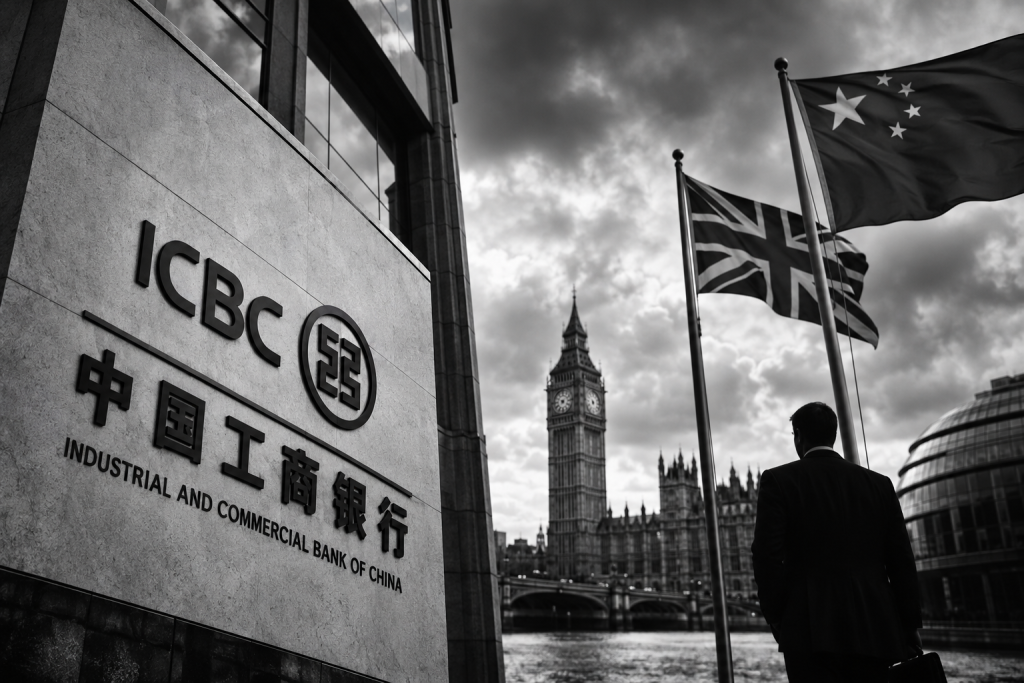
CBC China Capital Records Highlight Cross-Border AML Compliance Risks
A major document-based investigation into the Industrial and Commercial Bank of China has placed a familiar compliance problem under renewed scrutiny: what happens when local financial-crime controls collide with commercial priorities, group-level instructions and strategically important clients?
On 14 September 2026, the International Consortium of Investigative Journalists’ China Capital investigation was published with 23 media partners, based on approximately 4.8 million confidential ICBC records.
The documents reportedly include internal emails, client files, due-diligence reports, meeting minutes and suspicious-transaction records from ICBC’s London operations. ICIJ provides further detail on the records and methodology in its overview of the China Capital investigation.
ICIJ reports that the records show occasions when ICBC London officers breached or waived internal anti-money-laundering and sanctions policies, including when dealing with politically connected or otherwise high-risk customers.
These are findings reported by ICIJ from confidential documents, not findings of regulatory liability by a court or regulator.
For compliance teams, lawyers and investigators, however, the more important question is not simply what happened at one bank.
It is how cross-border organisations can determine whether their AML, sanctions and enhanced due-diligence controls continue to operate effectively when headquarters, overseas branches, high-value clients and different regulatory environments pull in different directions.
For organisations facing similar questions, independent company due diligence and broader investigation services can help establish whether formal controls match what is actually happening operationally.
What the China Capital Records Reportedly Show
According to ICIJ, the China Capital investigation examined records from ICBC’s London branch and UK subsidiary spanning approximately two decades.
The files reportedly include information concerning more than 4,000 corporate clients as well as agreements associated with around 200 loans involving borrowers across numerous jurisdictions.
ICIJ’s broader reporting on ICBC, international clients and sanctions-related risks describes occasions where customers regarded as commercially or strategically important allegedly received exceptions to internal procedures.
The records also reportedly document disagreements between local compliance personnel, business managers and ICBC’s headquarters in Beijing over how certain customers should be handled.
That distinction matters.
A financial institution can have detailed AML policies, sanctions screening procedures and customer-risk methodologies on paper.
The more difficult investigative question is whether those controls continue functioning when a commercially significant transaction reaches an escalation point.
This is where corporate investigations and enhanced due diligence often need to go beyond reviewing written procedures.
Investigators may need to reconstruct what actually happened, who made the decision and what information was available at the time.
The US$1.3 Billion Huawei Transfer: A Governance Question, Not Simply a Sanctions Question
One of the most prominent episodes identified by ICIJ concerns Huawei.
On 28 January 2019, the US Department of Justice unsealed an indictment charging Huawei, several affiliates and Huawei CFO Meng Wanzhou with offences that included allegations concerning bank fraud, money laundering and violations of US sanctions laws.
The allegations were charges rather than findings of guilt.
The original announcement remains available from the US Department of Justice.
ICIJ reports that ICBC London temporarily suspended business with Huawei while seeking additional information concerning the allegations.
Days later, Huawei reportedly requested that approximately US$1.3 billion be transferred from its London account to an account in Shenzhen.
According to ICIJ’s detailed reporting on Huawei and ICBC, ICBC headquarters approved the transfer and London personnel executed it on Saturday, 2 February 2019.
Importantly, ICIJ states that the transaction itself was not illegal.
The branch’s compliance team reportedly learned about the transfer afterwards and an internal investigation followed.
That distinction is critical.
The investigative significance of the episode does not depend on describing the transfer itself as unlawful.
Instead, it raises questions about decision-making, escalation and control effectiveness.
Who Actually Had Authority to Override or Modify the Local Risk Position?
A multinational organisation may have global policies, regional management and local compliance functions operating simultaneously.
Investigators therefore need to identify who possessed formal decision-making authority — and whether the actual decision followed that structure.
An approval email alone may not answer the question.
An effective internal investigation may need to reconstruct the sequence of discussions, telephone calls, internal messages, compliance warnings and management instructions surrounding the decision.
Was Compliance Consulted Before the Transaction or Informed Afterwards?
Timing can be as important as the final decision.
A control that technically exists but enters the decision-making process only after a high-risk transaction has taken place is very different from a control that can stop, delay or escalate the transaction beforehand.
This is why internal investigations frequently focus on the chronology of a decision rather than simply collecting individual documents.
For legal and compliance teams, the key question is often not simply what was decided, but who knew what, when they knew it and what happened next.
Pressure Point 1: Headquarters Versus Local Compliance
Cross-border companies routinely need to balance centralised governance with local regulatory obligations.
That can create tension when headquarters views a customer through a global commercial relationship while a local branch evaluates the same customer through a jurisdiction-specific financial-crime framework.
The UK’s Financial Conduct Authority financial-crime guidance emphasises the importance of effective systems, controls, governance and risk management.
The FCA’s 2026 review of sanctions systems and controls also identified weaknesses where some firms failed adequately to incorporate risks arising from overseas branches into management information and reporting.
For investigators reviewing a similar situation, the question should therefore be:
Did the group governance model strengthen local compliance — or unintentionally provide a route around it?
This is particularly relevant in businesses operating across multiple jurisdictions where decision-making authority may be divided between headquarters, regional offices and local management.
Pressure Point 2: Strategic Clients Can Distort Risk Decisions
The China Capital reporting repeatedly refers to customers viewed by ICBC as strategically important.
Commercial importance does not itself indicate wrongdoing.
But it creates an important investigative variable.
Where revenue, strategic relationships or senior-management interest are significant, investigators should compare how the organisation treated that customer against how comparable risks were handled elsewhere.
Questions may include:
- Did the customer receive exceptions unavailable to others?
- Were approvals accelerated?
- Was enhanced due diligence delayed?
- Were decisions documented retrospectively?
- Were escalation thresholds applied consistently?
- Did senior management influence the compliance process?
- Was the rationale for any exception recorded?
The objective is not simply to ask whether an exception existed.
It is to determine why it existed, who approved it, whether the rationale was documented and whether equivalent customers were treated consistently.
For high-risk relationships, that can require combining document review with corporate investigation services, independent verification and discreet source enquiries.
Where the concern arises before a transaction or investment, a structured company due diligence investigation can also help identify ownership, operational and reputational risks before they become disputes.
Pressure Point 3: Entity Resolution Matters More Than Name Screening
Sanctions investigations increasingly depend on understanding relationships between people, companies, shareholders, affiliates and controlling interests.
Checking whether a company name appears on a sanctions list is only the starting point.
Investigators may need to determine:
Who ultimately owns the entity?
Who controls it in practice?
Are there nominees, proxies or undisclosed beneficial owners?
Do directors overlap with other high-risk companies?
Are sanctioned shareholders present further up the ownership chain?
Has ownership recently changed?
The UK’s Office of Financial Sanctions Implementation provides extensive financial sanctions guidance covering ownership, control, due diligence and compliance considerations.
This is one reason why UBO identification, corporate mapping and entity resolution are increasingly important in sanctions and financial-crime investigations.
A name-screening alert may identify the starting point.
The investigative task is resolving the entity behind it.
Independent company due diligence can help establish beneficial ownership, corporate relationships, management links and other risk indicators that may not be obvious from a simple database search.
Pressure Point 4: Escalation Procedures Need to Work Under Pressure
Written policies often describe escalation clearly.
Real cases are rarely as orderly.
Large transactions may occur outside normal hours.
Senior executives may intervene.
Commercial teams may seek rapid decisions.
Headquarters may have information unavailable to the local branch.
Compliance staff may disagree about the correct risk classification.
The effectiveness of an escalation framework therefore depends on more than its existence.
Investigators should establish whether:
- Compliance had sufficient information.
- Concerns were formally recorded.
- Staff understood the escalation process.
- Senior management could override local decisions.
- Exceptions required independent approval.
- Dissenting views were preserved.
- Post-transaction reviews resulted in meaningful remediation.
A strong policy that repeatedly fails when important commercial decisions arise may indicate a governance problem rather than simply a documentation problem.
Pressure Point 5: Group-Wide AML Controls Must Survive Different Jurisdictions
The ICBC reporting also illustrates a broader problem faced by multinational financial institutions and international companies:
A global compliance programme has to function across different legal systems, commercial environments and corporate cultures.
The Financial Action Task Force expects financial groups to maintain group-wide programmes against money laundering and terrorist financing, including appropriate policies, controls and procedures for information sharing.
The challenge is making those requirements operational.
A multinational group may have sophisticated policies centrally while still experiencing inconsistent implementation at individual branches.
Different countries may apply different legal standards.
Local staff may interpret risk differently.
Commercial priorities may differ between headquarters and regional offices.
Internal information may not flow effectively across borders.
That gap is where independent investigation can become useful.
What Should a Cross-Border Compliance Investigation Test?
A properly scoped investigation should reconstruct how the organisation actually makes decisions, rather than limiting the review to whether policies exist.
That may involve comparing formal procedures against transaction records, internal communications, corporate structures, escalation logs and interviews.
Investigators can examine:
1. Origin of the Customer Relationship
Who introduced the customer?
Was the customer referred by senior management?
Was there a politically connected intermediary?
Did the relationship originate locally or through headquarters?
2. Beneficial Ownership
Who ultimately owns or controls the customer?
Are nominee shareholders involved?
Do shareholder or director relationships connect the entity to higher-risk individuals or companies?
3. Adverse Information
What negative media, litigation, enforcement or regulatory information existed at the time?
Was it identified by compliance?
If so, how was it assessed?
4. Transaction Chronology
When did relevant events occur?
When did compliance become aware of the risk?
When did management make its decision?
When was the transaction executed?
5. Escalation
Who approved the decision?
Were local concerns escalated?
Did headquarters override or influence the decision?
Was the rationale recorded?
6. Enhanced Due Diligence
Was enhanced due diligence performed?
Was source of funds or source of wealth considered where relevant?
Were ownership and control verified?
7. Post-Transaction Response
Was the matter reviewed afterwards?
Were controls changed?
Was the customer’s risk rating updated?
Were similar transactions identified?
Where necessary, documentary work can be supplemented with open-source intelligence, corporate-record analysis, discreet source enquiries and on-the-ground verification.
Compliancia’s professional investigation services are designed to combine these different sources of intelligence where public records alone do not provide the full picture.
For legal teams, the result should be a clearer timeline showing what information was available, who knew it, when they knew it and how the organisation responded.
Asset and Corporate Intelligence Can Become Relevant
Financial-crime and compliance matters do not always stop at customer due diligence.
Where concerns develop into litigation, fraud allegations or enforcement matters, legal teams may also need to understand where assets are held, how companies are connected and whether ownership structures have changed.
In those circumstances, asset discovery and asset tracing investigations may complement broader corporate intelligence work.
An investigation may examine companies, directors, shareholders, property interests, litigation history, related entities and other indicators that help establish a more complete picture of the subject’s financial position.
This can be particularly valuable in cross-border disputes where assets and corporate structures span multiple jurisdictions.
Lessons for Compliance Teams Beyond ICBC
The China Capital investigation should not be treated as proof that every cross-border disagreement between headquarters and a branch represents a compliance failure.
Large financial institutions routinely manage difficult customers, conflicting information and different regulatory regimes.
The more useful lesson is methodological.
When significant financial-crime risk emerges, organisations should be capable of demonstrating a defensible chain of reasoning:
Risk identification → Enhanced due diligence → Escalation → Decision → Documentation → Monitoring
Where that chain breaks, an apparently strong compliance programme can become difficult to defend.
The FCA’s work on sanctions systems and controls reinforces the importance of assessing customer exposure, jurisdictions, products, transactions and the effectiveness of existing controls rather than relying excessively on screening software or third-party databases.
Technology can assist the process.
But identifying risk and understanding the reality behind a transaction often requires more than automated screening.
Where Human Intelligence Adds Value
Public databases are valuable.
Sanctions screening tools are valuable.
AI-assisted document analysis is increasingly valuable.
But each has limitations.
Corporate structures may be misleading.
Nominee arrangements may obscure control.
Commercial relationships may not appear in formal records.
People with direct knowledge of an organisation’s operations may provide context that documents alone cannot establish.
Physical operations may also differ significantly from what appears online.
This is where human intelligence and on-the-ground investigation can add another layer of verification.
Compliancia combines corporate records, OSINT, document analysis, local enquiries and human-source intelligence to help clients independently corroborate information.
That approach is particularly useful in Southeast Asia, where corporate transparency, access to records and enforcement environments differ substantially between jurisdictions.
Investigative Intelligence for Cross-Border Compliance Matters
Compliancia is a Southeast Asia-focused investigation, intelligence and protective-services firm headquartered in Bangkok, with regional capabilities supporting clients across Thailand and other key Southeast Asian jurisdictions.
We assist law firms, corporate counsel, compliance professionals, companies and selected private clients with matters including:
- Corporate investigations
- Company due diligence
- Internal investigations
- Source enquiries
- Enhanced due diligence
- Beneficial ownership enquiries
- UBO and nominee identification
- Fraud investigations
- Asset discovery and tracing
- Litigation and dispute support
- Corporate intelligence
- Cross-border investigative research
Our investigative approach combines corporate records, OSINT, document analysis, local enquiries and on-the-ground intelligence to help clients understand the people, entities and relationships behind complex transactions.
The objective is not simply to produce more information.
It is to establish which information can be independently corroborated and how that information affects the decision being made.
Learn more about Compliancia and our investigative approach or explore our investigation services.
Editorial Note
This article discusses findings published by the International Consortium of Investigative Journalists as part of its China Capital investigation on 14 September 2026.
References to ICBC’s conduct reflect ICIJ’s reporting from confidential records unless otherwise stated. They should not be interpreted as independent findings by Compliancia or as regulatory or judicial determinations.
The US allegations concerning Huawei referenced above originated from criminal charges announced by the US Department of Justice. Allegations and criminal charges should not be treated as findings of guilt.