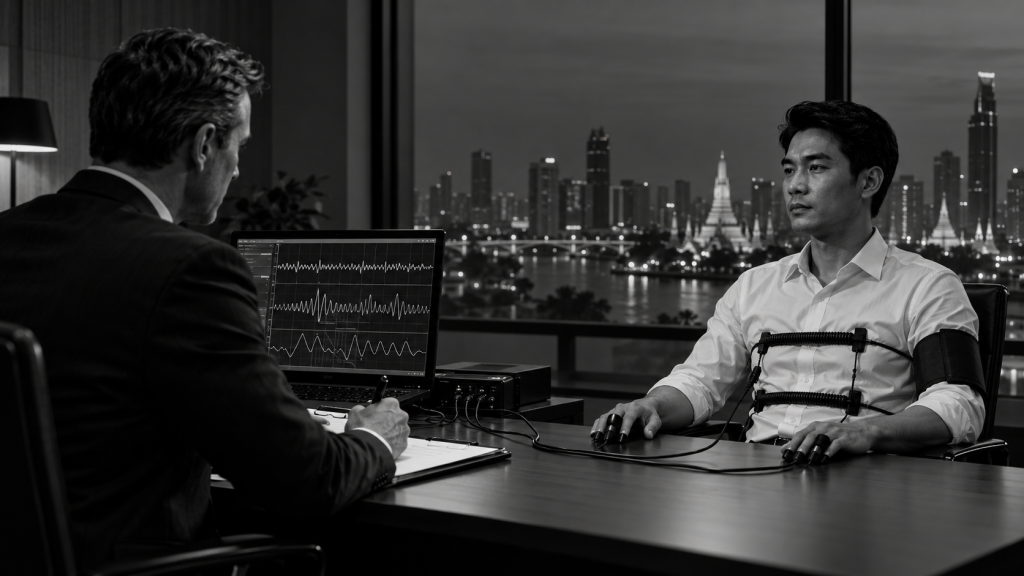
Polygraph Test Thailand: Compliancia Now Provides Professional Lie Detector Examinations
Compliancia has expanded its investigative capabilities in Thailand with the introduction of professional polygraph examinations, commonly known as lie detector tests.
Our polygraph test services in Thailand are designed to support companies, legal teams and selected private clients when a specific incident, allegation or disputed account requires further clarification.
Based in Bangkok and operating across Thailand, Compliancia combines polygraph examinations with its established professional investigation services in Thailand, including corporate investigations, employee misconduct enquiries, fraud investigations, source enquiries, asset discovery and litigation support.
What Is a Polygraph Test?
A polygraph examination records several physiological responses while an individual answers a structured series of questions.
Depending on the equipment and examination methodology, measurements may include changes in:
- Breathing patterns
- Cardiovascular activity
- Skin conductivity
- Other physiological responses
The examination is commonly referred to as a lie detector test, although this term can be misleading.
A polygraph does not directly identify a lie. Instead, it records physiological changes occurring while questions are being answered. These responses are then assessed according to the examination methodology being used.
The American Psychological Association’s overview of polygraph testing notes that physiological reactions such as increased heart rate or sweating can occur for reasons other than deception, including nervousness.
For this reason, Compliancia treats a polygraph examination as an investigative assessment tool rather than standalone proof of truth or deception.
When Can a Polygraph Examination Be Useful?
Polygraph testing can be considered when investigators, companies or individuals are attempting to clarify conflicting accounts relating to a specific incident.
Depending on the circumstances, this may include internal theft, suspected fraud, information leaks, workplace misconduct or other situations in which different individuals provide contradictory explanations.
Employee Theft and Internal Misconduct
Companies investigating suspected theft, fraud, unauthorised disclosure or other employee misconduct can face significant difficulties establishing exactly what happened.
Documents and financial information might identify that a loss occurred without immediately establishing who was responsible.
A carefully structured polygraph examination may therefore be considered as one component of a broader investigation.
Compliancia already provides workplace investigation services in Thailand for companies dealing with suspected employee misconduct and internal incidents.
A polygraph examination can potentially complement investigative interviews, document reviews, CCTV analysis and other investigative measures.
Fraud Investigations
Fraud investigations rarely depend on a single piece of information.
Investigators may need to examine:
- Financial transactions
- Employee explanations
- Corporate documents
- CCTV
- Communication records
- Witness accounts
- Business relationships
- Undisclosed interests
- Source intelligence
Where several people provide conflicting versions of events, a polygraph examination may provide an additional investigative perspective.
However, its findings should normally be considered alongside corroborating information rather than in isolation.
This reflects Compliancia’s broader approach to private investigation services in Thailand, where information from different sources is examined to develop a clearer understanding of the facts.
Workplace Investigations
Internal investigations frequently involve allegations where direct evidence is limited.
Examples can include:
- Theft of company property
- Expense fraud
- Confidentiality breaches
- Information leakage
- Procurement irregularities
- Kickbacks
- Unauthorised transactions
- Undisclosed conflicts of interest
- Asset misuse
- Other employee misconduct
In these situations, the objective should not simply be to determine whether an employee “passes” or “fails” a lie detector test.
Instead, investigators should consider the overall circumstances of the incident and determine what additional enquiries may be required.
For example, information obtained during an examination might identify a transaction, individual, location or event requiring further investigation.
Commercial and Business Disputes
Commercial disputes often involve competing accounts of what occurred.
A disagreement might concern:
- Whether a meeting took place
- Whether particular information was disclosed
- Who authorised a transaction
- Whether confidential information was shared
- Who had knowledge of an event
- Whether an individual participated in a particular action
Where questions relate to clearly defined factual events, polygraph testing may potentially provide another investigative perspective.
However, questions involving vague intentions, opinions or predictions generally require much greater caution.
Private and Sensitive Matters
Selected private clients may also request a lie detector test in Thailand to clarify a particular allegation or disputed incident.
Private matters can be highly sensitive, and a polygraph examination should not automatically be considered appropriate for every disagreement.
Before conducting an examination, the circumstances and proposed questions should first be assessed.
Where a matter requires broader fact-finding, Compliancia can also provide private investigator services in Thailand.
How Does a Polygraph Test Work?
A professional polygraph examination normally involves several stages.
1. Initial Case Assessment
The first stage is understanding the circumstances surrounding the matter.
This may include reviewing:
- The allegation or disputed incident
- Relevant background information
- Existing evidence
- Individuals involved
- Important dates
- The specific questions requiring clarification
This initial assessment is important because not every question is suitable for polygraph examination.
A narrowly defined factual question is generally more suitable than a broad question relating to somebody’s opinion or future intention.
2. Pre-Test Interview
Before testing begins, the examination process and questions are discussed with the examinee.
Questions should normally concern clearly identifiable events.
The objective is to remove unnecessary ambiguity so that both the examiner and examinee understand exactly what is being asked.
3. Polygraph Examination
During the examination, sensors connected to polygraph equipment record physiological responses while a structured series of questions is administered.
The resulting data is subsequently reviewed according to the relevant examination methodology.
4. Assessment and Reporting
Following the examination, the recorded information is reviewed and the findings documented.
Where polygraph testing forms part of a wider investigation, the result may then be considered alongside other evidence and intelligence.
Polygraph Testing Should Not Replace Investigation
One important distinction between using an investigative firm and simply booking a standalone lie detector test is what can happen before and after the examination.
Complex investigations rarely depend upon one source of information.
Consider an internal fraud investigation.
A polygraph examination might address whether an employee knew about a suspicious transaction.
However, investigators may still need to establish:
- Where the money went
- Who controlled relevant companies
- Whether other employees were involved
- Whether undisclosed relationships existed
- Whether assets were acquired
- Whether company records were manipulated
- Who ultimately benefited
Polygraph testing therefore works best when considered within a broader investigative strategy rather than as an automatic substitute for evidence.
When financial interests are involved, Compliancia can also conduct asset discovery investigations in Thailand and internationally to identify potentially relevant companies, property and financial connections.
Can a Lie Detector Test Prove Someone Is Lying?
A polygraph should not be treated as infallible.
The instrument records physiological reactions rather than directly detecting deception.
Stress, nervousness and other psychological or physiological factors may influence these responses.
The National Academies’ scientific review of polygraph testing examined research concerning the scientific basis, accuracy and limitations of polygraph examinations.
Its findings highlight why polygraph results should be evaluated carefully and according to the circumstances in which testing occurs.
For serious investigations involving potential employment, disciplinary, commercial or legal consequences, relying exclusively on a polygraph result would therefore be inappropriate.
Instead, investigators may need to corroborate information through:
- Documentary evidence
- Witness interviews
- Financial information
- Digital information
- CCTV
- Surveillance
- Corporate records
- Source enquiries
- Asset investigations
- Other investigative intelligence
This corroborative approach is particularly important when conclusions could have substantial consequences for the individuals or companies involved.
Polygraph Tests for Corporate Investigations in Thailand
Thailand hosts multinational corporations, manufacturing operations, hospitality businesses, financial organisations, family-owned companies and regional business operations.
When an internal incident occurs, determining exactly what happened can sometimes be difficult.
Documents might establish that company property disappeared or that an unauthorised transaction occurred without explaining who was responsible.
Potential corporate applications for polygraph examinations may therefore include investigations involving:
- Internal theft
- Expense fraud
- Procurement irregularities
- Kickbacks
- Information leakage
- Confidentiality breaches
- Undisclosed conflicts of interest
- Asset misuse
- Inventory losses
- Unauthorised access
- Internal fraud
- Other employee misconduct
The suitability of a polygraph examination should always be evaluated according to the facts of the particular case.
Polygraph Support for Lawyers and Legal Teams
Compliancia regularly supports law firms, corporate counsel and dispute teams with investigative intelligence in Thailand and Southeast Asia.
Legal disputes do not always remain within the documents.
Witnesses may provide contradictory accounts, assets may be concealed, beneficial ownership structures may be unclear and important events may require independent verification.
Where appropriate, polygraph examinations may be discussed as one possible investigative measure within a wider matter.
However, legal teams should separately consider the evidentiary status and legal implications of using any polygraph findings within relevant proceedings.
A polygraph examination should not automatically be regarded as court evidence or as a substitute for independently verified facts.
Its investigative value may instead lie in helping identify:
- Areas requiring further enquiry
- Inconsistencies requiring verification
- Additional witnesses
- Documents requiring examination
- Events requiring corroboration
- Potential investigative leads
Combining Polygraph Testing With On-the-Ground Investigation
A polygraph examination may sometimes generate additional questions rather than provide the final answer.
This is where having investigators on the ground becomes particularly important.
Depending on the circumstances, Compliancia can combine polygraph examinations with:
- Corporate intelligence
- Surveillance
- Covert site visits
- Witness identification
- Source enquiries
- Employee investigations
- Asset tracing
- Corporate record research
- Beneficial ownership enquiries
- Background investigations
- Litigation support
Our existing investigation capabilities in Thailand allow the examination to form part of a broader investigative strategy where additional verification is required.
Confidential Polygraph Testing in Bangkok
Compliancia is headquartered in Bangkok and provides discreet investigative support throughout Thailand.
Polygraph examinations can be arranged following an initial assessment of the matter.
Confidentiality is particularly important because many polygraph enquiries involve sensitive situations concerning:
- Employees
- Business partners
- Fraud allegations
- Corporate investigations
- Litigation
- Financial disputes
- Confidential information
- Personal matters
Engagements are therefore handled discreetly and according to the circumstances of each matter.
Why Use Compliancia for a Polygraph Test in Thailand?
Compliancia is not simply a polygraph testing provider.
We are an investigation, intelligence and protective services firm specialising in Thailand and Southeast Asia.
Our clients can therefore combine a polygraph examination with broader investigative capabilities where necessary.
These include:
- Corporate investigations
- Fraud and corruption investigations
- Employee misconduct investigations
- Asset tracing
- Litigation and dispute support
- Source enquiries
- Surveillance
- Business intelligence
- Background investigations
- On-the-ground fact finding
You can learn more about Compliancia and our investigative team.
Frequently Asked Questions About Polygraph Tests in Thailand
Is a Polygraph the Same as a Lie Detector?
The terms are commonly used interchangeably.
“Lie detector” is the phrase most people recognise, while polygraph examination more accurately describes the equipment and testing process.
A polygraph records physiological responses associated with structured questioning rather than directly detecting a lie.
How Accurate Is a Polygraph Test?
Polygraph accuracy remains scientifically debated and can depend on the methodology, circumstances, question structure and other factors.
For this reason, Compliancia does not treat polygraph results as absolute proof.
Polygraph findings should instead be considered alongside other available evidence and investigative information.
Can a Company Use a Polygraph During an Employee Investigation?
Polygraph testing may sometimes be considered as part of an internal corporate investigation depending on the circumstances.
Companies should carefully consider employee consent, privacy, employment obligations and legal implications before proceeding.
Appropriate Thai legal advice should be obtained when significant employment or legal consequences may result.
Can I Arrange a Private Lie Detector Test in Bangkok?
Compliancia accepts enquiries from companies, law firms and selected private clients.
Our team will first assess the circumstances to determine whether polygraph testing is suitable for the matter.
Can a Polygraph Be Combined With an Investigation?
Yes.
This is one of the principal advantages of conducting a polygraph examination through an investigative firm.
Where additional issues emerge, Compliancia may be able to continue the enquiry through interviews, document review, field enquiries, source enquiries, surveillance, asset tracing or other investigative methods.
Looking for a Polygraph Test in Thailand?
If you need to clarify a specific allegation, disputed incident or conflicting account, Compliancia can assess whether a polygraph test in Thailand may be appropriate.
Our team provides confidential investigative support to companies, law firms, corporate counsel and selected private clients.
For confidential case consultations and polygraph examination enquiries:
Email: wecare@compliancia.com
Location: Bangkok, Thailand
Contact Compliancia to discuss your matter confidentially and determine whether a polygraph examination, broader investigation or combination of investigative methods would be appropriate.