Bali Asset Preservation Investigation: What a 23-Hectare Land Seizure Shows
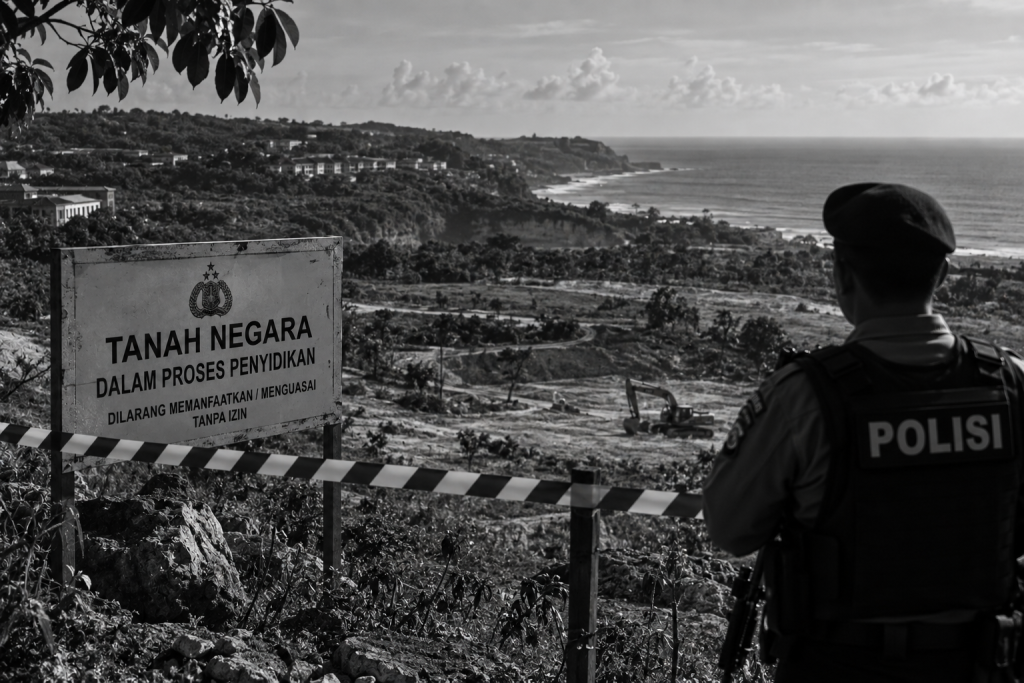
Bali asset preservation investigation procedures are under renewed attention following the seizure of approximately 23 hectares of state-owned land in Ungasan, South Bali, as part of an ongoing Indonesian police investigation.
The case is significant not because criminal responsibility has already been established, but because it demonstrates an important investigative sequence: secure the asset first, reconstruct the documentary and contractual history, and only then determine who may ultimately be responsible.
On 17 September 2026, Indonesia’s Corruption Crime Eradication Corps within the National Police, Kortastipidkor Polri, announced the seizure of approximately 230,450 square metres of land in Ungasan, South Kuta, Badung Regency.
According to the Indonesian National Police, the seizure was intended to preserve evidence, secure the asset and support possible future asset recovery while investigators continued examining the circumstances surrounding control of the land.
Reporting by detikBali stated that no suspect had been publicly named at the time of the seizure.
That distinction is critical.
The seizure itself does not prove criminal wrongdoing.
Instead, the Bali asset preservation investigation illustrates how investigators can stabilise a disputed asset while they continue examining ownership, possession, agreements, decision-making and economic benefit.
For lawyers, companies and investors, this sequence is highly relevant to complex disputes involving valuable land or other assets.
What Happened to the 23 Hectares of Land in Ungasan?
The disputed land is located in Ungasan, South Kuta, one of Bali’s most valuable development areas.
According to police reporting, the property was associated with a land-use certificate connected to Bali’s regional office of Indonesia’s National Land Agency, known as BPN.
Police say the case relates to a previous asset-exchange arrangement involving BPN and private company PT Marga Srikaton Dwipratama.
According to the Bali Police account, the private company was expected to provide a replacement government office building as part of the arrangement.
Investigators allege that this obligation was not completed.
Police also allege that the company had physically controlled the site since 2014 through fencing, signage and a security presence.
Meanwhile, the land certificate was later updated into the name of the Republic of Indonesia through the Ministry of Agrarian Affairs and Spatial Planning/National Land Agency.
This creates the type of situation where a corporate and property investigation may need to distinguish between several separate issues:
- Registered ownership
- Physical possession
- Contractual rights
- Government interests
- Reciprocal obligations
- Beneficial use
- Economic benefit
These concepts may overlap, but they are not necessarily identical.
Why the Bali Asset Preservation Investigation Matters
The key lesson from the Bali asset preservation investigation is that investigators do not always need to complete the entire theory of responsibility before taking steps to protect an important asset.
In complex cases, the asset itself can be central evidence.
If valuable land is transferred, mortgaged, subdivided, leased or otherwise encumbered while an investigation continues, recovery can become significantly more difficult.
Asset preservation may therefore need to happen before investigators fully determine:
- Who authorised the original transaction
- Who exercised control
- Whether contractual obligations were fulfilled
- Whether public officials acted improperly
- Whether a company received an unlawful benefit
- Whether individual or corporate liability may arise
This distinction is important in both criminal and civil asset matters.
Compliancia’s asset discovery and tracing services similarly focus on identifying assets and establishing relationships between property, companies and individuals before legal teams decide what recovery or preservation measures may be appropriate.
Step 1: Secure the Asset
The first stage in a significant asset investigation is often simple in principle:
Identify what exists and prevent the position from changing.
For land, investigators may need to confirm:
- Exact location
- Current title
- Registered owner
- Occupier
- Existing mortgages
- Leases
- Restrictions
- Recent transfers
- Development activity
- Third-party claims
In the Bali case, police described the seizure as a measure intended to maintain the integrity of evidence and secure the state asset.
That makes the Bali asset preservation investigation a useful example of how preserving an asset can support a broader investigation.
For private litigants, the legal tools available will depend on the jurisdiction.
However, investigators can still help counsel establish the factual position before applications for freezing orders, injunctions or other preservation measures are considered.
Step 2: Reconstruct the Land-Title History
Current ownership records are only one part of a property investigation.
Complex land cases often require a reconstruction of the entire title history.
Investigators may examine:
- Previous certificates
- Transfers
- Government approvals
- Asset-exchange documents
- Powers of attorney
- Historical company ownership
- Corporate resolutions
- Planning approvals
- Valuation documents
- Correspondence
- Court records
A current certificate may identify today’s registered owner.
It does not necessarily explain how the property reached that position.
For that reason, a proper investigation may need to build a chronological title map showing how ownership, rights and possession changed over time.
Step 3: Reconstruct the Contractual Obligations
The next question is often more important than the title itself:
What were the parties supposed to do?
According to police, the Ungasan matter involved a reciprocal arrangement under which the private party was allegedly expected to provide a replacement government building.
Investigators say that obligation was not completed.
In such situations, investigators may need to reconstruct:
- The original agreement
- The obligations of each party
- Conditions precedent
- Completion deadlines
- Amendments
- Payment obligations
- Construction requirements
- Government approvals
- Notices of breach
- Subsequent negotiations
This documentary reconstruction can become especially important when the original arrangement dates back many years.
Personnel may change.
Companies may restructure.
Records may become fragmented across departments.
A structured company due diligence investigation can help establish the corporate history behind the parties involved.
Step 4: Compare Legal Ownership With Physical Control
One of the most useful investigative questions in land disputes is:
Who owns the property on paper, and who actually controls it in practice?
Those answers can differ.
A government entity may hold title while a private company controls access.
A company may hold a lease while another party operates the property.
A shareholder may appear unrelated on paper while exercising effective control through intermediaries.
Police allege that the private company in the Ungasan case maintained fences, signage and a security post on the site.
Physical control can therefore become an important evidential question.
This is where desk research alone may be insufficient.
An on-the-ground investigation may include:
- Site visits
- Photographic verification
- Neighbourhood enquiries
- Occupancy checks
- Interviews
- Local-source enquiries
- Historical imagery review
- Verification of construction
- Verification of commercial operations
In property investigations, the reality on the ground can differ significantly from the documentary record.
Step 5: Map the Stakeholders
Once the asset and contractual structure are understood, investigators can begin identifying the people and entities involved.
Stakeholder mapping may include:
- Company directors
- Shareholders
- Beneficial owners
- Government officials
- Tender committee members
- Contractors
- Consultants
- Lawyers
- Property managers
- Intermediaries
- Related companies
Reporting by detikBali stated that investigators had interviewed witnesses from government bodies and private companies connected with the site.
Investigators were also reportedly consulting criminal-law experts.
No suspect had been publicly named in the reviewed reporting at that stage.
That illustrates an important point.
A person’s formal job title does not itself establish responsibility.
Investigators need to determine:
Who actually made the decisions? Who knew about them? Who authorised them? And who benefited?
Step 6: Follow the Economic Benefit
Ownership and benefit are not always the same.
A company may not formally own land but may still generate commercial value from controlling it.
Investigators may therefore ask:
- Was the land developed?
- Was rent collected?
- Were licences granted?
- Was it used as collateral?
- Did another company operate from the site?
- Did the value increase significantly?
- Were development rights obtained?
- Were related-party transactions involved?
- Did ownership structures change?
This is where asset discovery and corporate intelligence increasingly overlap.
An asset investigation should not simply identify the registered owner.
It should attempt to establish who exercises economic control and who receives the benefit.
The Reported Rp4.8 Trillion Valuation
The value attached to the land requires careful interpretation.
The Indonesian National Police referred to a potential value of approximately Rp4.8 trillion.
However, that figure should not automatically be treated as proven state loss.
An asset may have several different valuations:
- Market value
- Historical value
- Replacement value
- Book value
- Economic benefit
- Alleged state loss
- Recoverable value
These figures are not interchangeable.
For investigators and legal teams, defining the valuation methodology is therefore essential.
A headline number may attract attention, but the evidential question is:
What exactly does that number represent?
Asset Preservation Is Not the Same as Asset Recovery
Finding or preserving an asset does not mean it can automatically be recovered.
That distinction matters.
An investigator may establish that:
- An asset exists
- A company controls it
- A person owns the company
- The asset was transferred
- A nominee appears involved
- A related party benefits
But legal recovery generally requires separate legal action.
Depending on the jurisdiction, that may involve:
- Court orders
- Injunctions
- Enforcement procedures
- Insolvency processes
- Criminal confiscation
- Civil recovery proceedings
The investigator’s role is often to help establish:
What exists, where it is, who controls it and what evidence supports that conclusion.
Legal counsel can then determine the appropriate remedy.
Compliancia supports lawyers with litigation-related investigations where asset intelligence forms part of a wider dispute or enforcement strategy.
Lessons for Investors in Bali and Southeast Asia
The Bali asset preservation investigation also illustrates why property due diligence should go beyond checking a current title document.
Investors may need to examine:
- Historical ownership
- Government interests
- Prior agreements
- Possession
- Litigation
- Encumbrances
- Boundary disputes
- Planning restrictions
- Corporate ownership
- Beneficial ownership
- Outstanding obligations
- Physical site conditions
The principle is straightforward:
Verify the records, then verify the reality behind the records.
This is especially important for high-value transactions in jurisdictions where corporate ownership, land-use rights and local possession may require separate analysis.
How Compliancia Supports Asset and Property Investigations
Compliancia supports law firms, corporate counsel, companies and selected private clients with investigative intelligence across Southeast Asia.
Relevant services include:
- Asset discovery and tracing
- Corporate investigations
- Property investigations
- Land-title intelligence
- Beneficial ownership research
- UBO and nominee identification
- Document reconstruction
- Source enquiries
- Site verification
- Fraud investigations
- Litigation support
- Business-partner investigations
- Pre-investment due diligence
Our investigators combine corporate records, OSINT, document analysis, source enquiries and on-the-ground verification.
The objective is not simply to collect more information.
It is to establish a defensible sequence:
What asset exists?
Who owns it?
Who controls it?
What agreements govern it?
Who made the relevant decisions?
Who benefited?
And what evidence supports those conclusions?
Learn more about Compliancia’s investigation services, our asset discovery capabilities or Compliancia.
Editorial Note
This article discusses an ongoing investigation in Indonesia based on information publicly reported in September 2026.
The seizure of the Ungasan property should not be interpreted as proof of criminal responsibility by any individual or company.
Descriptions of the land-swap arrangement, physical control of the property, contractual obligations and potential asset value reflect statements attributed to Indonesian police and media reporting.
The reported Rp4.8 trillion valuation should be treated as an indicative figure cited during the investigation and not as an independently verified valuation or final determination of state financial loss.
Relevant public reporting includes the Indonesian National Police, Bali Police and detikBali.